Chosen
Today on Choosing Peace, you’ll experience a bit of a bluegrass festival, with four songs imbedded in the post and another one at the end. I hope you thoroughly enjoy them, as I have.
You’ll also read three Chosen By God stories.
Impressions
When we hear certain people’s names, we immediately have a particular impression. If you recognize names like Mookie, Shohei and Kike, you know we’re talking about the Dodgers, who won last year’s World Series. (It was epic!)
When you hear biblical names—Paul, Rahab and David—what’s your immediate thought about each one of them?
I hope today’s exploration will give you some food for thought.
The end of the passage
Earlier this month, we started our dive into the Bible passage where I’m lingering daily. From part 3: “Since November, I’ve been lingering at Colossians 1:9-14 for spiritual strength and encouragement during my season of surgeries, rest and simplicity.” For more about what I mean by lingering, see the beginning of part 4.
Let’s focus on the last three verses of this special passage in Colossians:
…the Father …has qualified us to share in the inheritance of the saints in light. He has delivered us from the dominion of darkness and transferred us to the kingdom of his beloved Son, in whom we have redemption, the forgiveness of sins.
Colossians 1:12b-14, Revised Standard Version*
*Revised Standard Version of the Bible, copyright © 1946, 1952, and 1971 the Division of Christian Education of the National Council of the Churches of Christ in the United States of America. Used by permission. All rights reserved.
The family of God
The apostle Paul wrote the letter quoted above to the church at Colossae, an ancient city in modern-day Turkey. Words like Father, qualified, share, inheritance, and beloved Son paint a clear picture of familial ties and permanent benefits. In verses 12 thru 14, Paul definitively communicates that followers of Christ Jesus—true believers saved by the Lord—are lawful heirs with an inheritance.
Qualified and chosen
The word “qualified” is quite rare in the Bible. We know from verse 12 that God, our Father, “qualified us to share in the inheritance….” The instant we were saved, we were qualified. We didn’t earn our salvation or our qualification for our heavenly, eternal inheritance. Verse 14 above reminds us that in Jesus, “we have redemption, the forgiveness of sins.” Jesus saved us, redeemed us, reconciled us to God, and forgave our sins.
Now thanks be to God for his unspeakable gift!
2 Corinthians 9:15, World English Bible
While we may not understand why we—or other people—were chosen by God, remember these sentiments from the epic story of Joseph:
God will not be constrained by our sensibilities. He chooses the ones he chooses, regardless of birth order, appearance or skills. He chooses. And he always chooses rightly.
God also chooses his children regardless of our family tree, who we know, where we came from, our intelligence—or lack thereof, our social or financial status, our problems or our sins. People commonly reject God or question his election or choosing of them—perceiving themselves to be unqualified. “I’m not good enough,” “I’m not smart enough,” “I’m not talented enough,” etc.

Three stories
In addition to repeatedly describing salvation as a gift, God’s word demonstrates in people’s stories that “good behavior” is not a prerequisite for salvation—for receiving it or keeping it. Let’s reflect on three of my favorite Chosen By God stories.
Paul, the zealous
The greatest Christian missionary of all time wrote the words we’ve been studying.
From murderer to missionary
Before his salvation, Paul traveled far and wide, violently persecuting Christians to the death.
I persecuted this Way [—faith in Jesus—] to the death, binding and delivering into prisons both men and women….
Acts 22:4, World English Bible
Perhaps we can surmise from the verse above that men and women captured by Paul were later executed. In the story of Stephen (found in Acts 6 and 7), Paul’s job was to watch everyone’s cloaks while they stoned Stephen to death for preaching about Jesus. (Before his salvation, Paul was called Saul.) Stamping out Christians was Paul’s #1 endeavor. He was good at it and he knew he was doing the right thing.
Then Paul met Jesus on the road to Damascus, and the rest is history.
Chosen to build the church
Paul was highly-educated, brilliant and zealous. And he was a fearless traveler. In the hands of God Almighty, he changed the world. Paul traveled far and wide for the cause of Christ—preaching, teaching, starting churches and encouraging believers. He suffered harsh persecution and wrote about joy in the Lord Jesus.
The bluegrass song “Prayer Bells” includes Paul and Silas in jail. What a sweet surprise to hear this festive song for the first time on a recent cold, rainy day.
The letters
Paul wrote four of his letters, including Colossians, while imprisoned in Rome. He understood persecution in a very personal way, having been a persecutor of the church. He also understood how God was using his imprisonment to further the gospel and accomplish God’s will.
Paul was chosen by the Lord.
He was the right person for essential tasks—
spreading the early Christian church
and writing many books of the Bible.
Did Paul become “walking perfection” after his salvation? Certainly not. Neither do we. In fact, he wrote these words in his letter to the Romans—words which encourage us today.
For I know that in me, that is, in my flesh, dwells no good thing. For desire is present with me, but I don’t find it doing that which is good. For the good which I desire, I don’t do; but the evil which I don’t desire, that I practice.
Romans 7:18-19, World English Bible
The verses above begin the intro to the epic chapter of the Bible—Romans 8, which begins like this:
There is therefore now no condemnation to those who are in Christ Jesus.
Romans 8:1, New Heart English Bible
For more, read Romans 7:18 thru 8:6. See this short article about Paul, which includes a list of the 13 books of the New Testament written/dictated by Paul—inspired by the Holy Spirit. Two of my favorite Bible passages were written by Paul: Philippians 4:4-9 and Ephesians 3:14-21. Are any of your favorites found in Paul’s letters?
Lord, we thank you for our brother, Paul—diligent and full of faith.

Rahab, the courageous
Most of the time, you’ll hear Rahab described as Rahab the prostitute. I’m not going to do that. There was so much more to her life. Wisdom. Courage. Faith. And a remarkable destiny—in the lineage of our beautiful Savior, Jesus Christ.
Commended
From part 1 of The Mirror:
…when Rahab is commended in The Hall of Faith in Hebrews, we’re reminded to admire her for her remarkable courage and faith. Rahab’s story was told in the Old Testament book of Joshua. Her commendation came in the New Testament book of Hebrews. I love that. God gets the final word.
Yes, Rahab was a prostitute. No second grader dreams of being a prostitute when she grows up. Rahab’s life wasn’t what she’d hoped it would be. At all. Still, the Lord had a calling on her life. She obeyed. She was rescued. She was an ancestor of Jesus Christ. And she was commended in The Hall of Faith. I’ll say it again. God gets the final word.
Climate and force
What was the cultural climate in Jericho, where Rahab and her family lived? What happened in Rahab’s life? When did she become a prostitute? Was she trafficked or sexually abused as a child? We know very few details. Joshua 2:12-13 tells us that Rahab lived with her father, mother, brothers, sisters and her siblings’ families. It sounds like a big family. Was Rahab forced into prostitution by one or more of these realities within the family—illness, famine, disability, injuries, catastrophe, or sins like recklessness, gambling, sloth, alcohol or drug use, foolishness, irresponsible spending? Did her parents run a brothel? Or was she forced into prostitution by someone in the corrupt, pagan Canaanite stronghold where she lived—the walled city of Jericho? We don’t know.
We do know this: “No second grader dreams of being a prostitute when she grows up.” And no person wants to be bought and sold.
Prostitution and slavery are degrading, humiliating and traumatic. A person made in the image of God is reduced to the market’s produce, whether or not a cage or chains are involved. Prostitution and slavery are inherently extremely dangerous. Normal societal protections are significantly reduced or entirely erased, depending on the circumstances. (For more on slavery and trafficking, see Violence in the index.)
Chosen to protect
Why was Rahab commended in the Hall of Faith in the book of Hebrews? What did she do? Rahab protected the Israelite spies who were sent to scope out Jericho—hiding them on her roof. When the king’s men came to Rahab looking for the spies, she sent them on a fool’s errand outside the city gates.
How was Rahab able to pull this off with the king’s men? She was calm and quick-thinking. Most of us would be quaking in our boots—sweating, looking down or away, turning red, talking nervously or standing there, frozen stiff. Did Rahab have experience hiding people when others came looking for them—like, for instance, men’s wives or employers? When people questioned her, did she have experience maintaining strict confidentiality for her customers? I believe she did. Was Rahab, perhaps, acquainted with one or more of the king’s men? Did they know each other?
Why did Rahab protect the Israelite spies? She knew they were the Lord’s men. Rahab understood and declared the power and authority of God Almighty. As a result of her faith and courage—and at her request—Rahab and her family were saved from the utter destruction that fell upon Jericho. Rahab joined the Israelites, married and had her own family. She was rescued from Jericho. She was rescued from prostitution. She was rescued from darkness and brought into the light. While most of Rahab’s story is told in Joshua, chapter 2 and chapter 6, I highly recommend the article, “Who was Rahab in the Bible?” It tells Rahab’s story and how her life displays core truths about salvation. I learned from this article that Rahab was the first Gentile convert recorded in the Bible, and much more.
Rahab was chosen by the Lord.
She was the right person for essential tasks—
protecting the Israeli scouts,
displaying the gift of salvation
and being one of Jesus’ ancestors.
Rahab’s song—our song
This beautiful, gentle rendition of “He Leadeth Me” by Sara Watkins gives me such comfort. It’s the perfect song for Rahab, who left her world behind and followed the Israelites into the unknown, knowing that God would be there. Be blessed by this hymn written during the Civil War—sung for us by a soft, tender voice.
Lord, we thank you for our sister, Rahab—discerning and full of faith.
David, the reverent
Key events
When we think of David—the shepherd boy who became the king of Israel—we often think about two of the key events in his life: David and Goliath, and David and Bathsheba.
David’s sin with Bathsheba and the subsequent murder of her husband Uriah didn’t represent a situation where David renounced or left his faith. It was sin. And there were serious consequences. Read this outstanding article from Got Questions about the two different types of “leaving the faith.” I found it extremely enlightening.
Here’s the thing. David’s most memorable chapters—David and Goliath, and David and Bathsheba—while undoubtedly monumental—comprised a tiny piece of David’s 70 to 71 years. Today, I’d like to focus on an aspect of his life that we tend to ignore: David’s rejection by his family.
The anointing
Let’s start with the scene of David’s anointing by the prophet Samuel. The Lord told Samuel to anoint the next king from among the sons of Jesse of Bethlehem.
From fear to festivities
The elders of Bethlehem were afraid when Samuel came to their little town. Why, pray tell? Samuel hacked King Agag of the Amalekites to pieces in the previous chapter of 1 Samuel because King Saul disobeyed the Lord and left him alive. The prophet Samuel hacked a pagan king to pieces. And word got around. The elders of Bethlehem were trembling when they saw Samuel, and asked him if he came in peace.
And [Samuel] said, “Peaceful; I have come to sacrifice to the LORD. Sanctify yourselves and celebrate with me today.” He sanctified Jesse and his sons, and called them to the sacrifice.
It happened, when they had come, that he looked at Eliab, and said, “Surely the LORD’s anointed is before him.” But the LORD said to Samuel, “Do not look at his appearance or at the height of his stature, because I have rejected him. For humans do not see as God sees, for humans look at the outward appearance, but God looks at the heart.”
1 Samuel 16:5-7, New Heart English Bible
Yes, indeed.
God looks at the heart.
The nation’s prophet coming to their small village was a massively big deal—perhaps a once-in-a-lifetime opportunity to be sanctified by Samuel, to offer sacrifices to God, and to feast and celebrate with the remarkable prophet of the Lord, Most High.
Excluded
And Jesse made seven of his sons pass before Samuel. But Samuel said, “The LORD has not chosen these.” Then Samuel said to Jesse, “Are all your [sons] here?” And he said, “There remains yet the youngest. Look, he is tending the sheep.” And Samuel said to Jesse, “Send and get him, for we will not sit down until he comes here.”
1 Samuel 16:10-11, New Heart English Bible
David was excluded from the sanctifying by Samuel. He was excluded from the sacrifice to God. He was excluded from everything that was happening on this monumental day. When Samuel asked if Jesse had any other sons, Jesse admitted that he had another son, but Jesse didn’t speak his son David’s name. He called him “the youngest.” David’s very existence seemed to be treated as an after-thought.
Honored publicly
Despite his rejection by his family, David was chosen by God and was anointed king in front of his seven older brothers that very day. I’m thinking that probably didn’t go over very well—human nature being what it is, and David’s obviously-low position in the family being what it was. (David’s reign as king began many years later.)
The verbal attack
Let’s fast forward from the day of the anointing to the scene of David and Goliath. Jesse told his son David, now a teenager, to take food to his three older brothers who were fighting in King Saul’s army. David left very early to make the 15-mile journey and left the sheep with “a keeper.” Goliath was taunting the army, and David talked with some of the men in the army, saying: “For who is this uncircumcised Philistine, that he should defy the armies of the living God?” (1 Samuel 17:26b, WEB). David spoke rightly and courageously.
Eliab his oldest brother heard when he spoke to the men; and Eliab’s anger burned against David, and he said, “Why have you come down? With whom have you left those few sheep in the wilderness? I know your pride and the evil of your heart; for you have come down that you might see the battle.”
David said, “What have I now done? Is there not a cause?”
1 Samuel 17:28-29, World English Bible
Golly. The exchange between Eliab and David revealed much. Eliab belittled and verbally attacked David in front of others, calling him prideful and evil. And it wasn’t the first time. David rightly asked him, “What have I done now?”
Revelations in the Psalms
In Psalm 27, my favorite psalm, David wrote that his parents had forsaken him.
David mentioned his brothers in another Psalm:
Because for your sake [—Lord—], I have borne reproach. Shame has covered my face. I have become a stranger to my brothers, an alien to my mother’s children. For the zeal of your house consumes me. The reproaches of those who reproach you have fallen on me. When I wept and I fasted, that was to my reproach. When I made sackcloth my clothing, I became a byword to them.
Psalm 69:7-11, World English Bible
The important question
Why was David treated poorly by his family? There are many possibilities, including a Jewish tradition about his mother. But the fact remains that we don’t know why.
The important question isn’t: “Why did David’s family reject him?” The important question is: “What did God do with that reality?”
Blessings in the wilderness
The many years David spent alone in the fields tending the sheep were deeply fruitful years. God was with him. David protected his sheep from danger. He honed his fighting skills—becoming an expert with a slingshot; and he killed lions and bears with his bare hands. He also became skilled playing the lyre and writing songs. Most of all, he loved God deeply, relied on him, and lived in humble reverence before the Lord. Even though David was far away from his family, emotionally and physically, he was ever close to God, who protected and strengthened him.
While David was in the wilderness,
God prepared him for what was to come—
building his skills, his courage and his faith.
Musician and poet
David wrote 75 of the Psalms in the Bible. His writing is filled with adoration and deep, personal understanding of God—rife with a full array of emotions. If David’s life had been easy and without struggle, he wouldn’t have written so eloquently about hard times—death threats, being hunted, lied about, maligned and ridiculed. If he’d been consistently “well-behaved,” he wouldn’t have been able to write about regret, remorse, contrition, sorrow, repentance and the Lord’s forgiveness. David’s greatest hardships and failures were the necessary realities for some of his greatest psalms about trusting God.
In scripture, David is called “the sweet psalmist of Israel.” That description paints a beautiful picture.
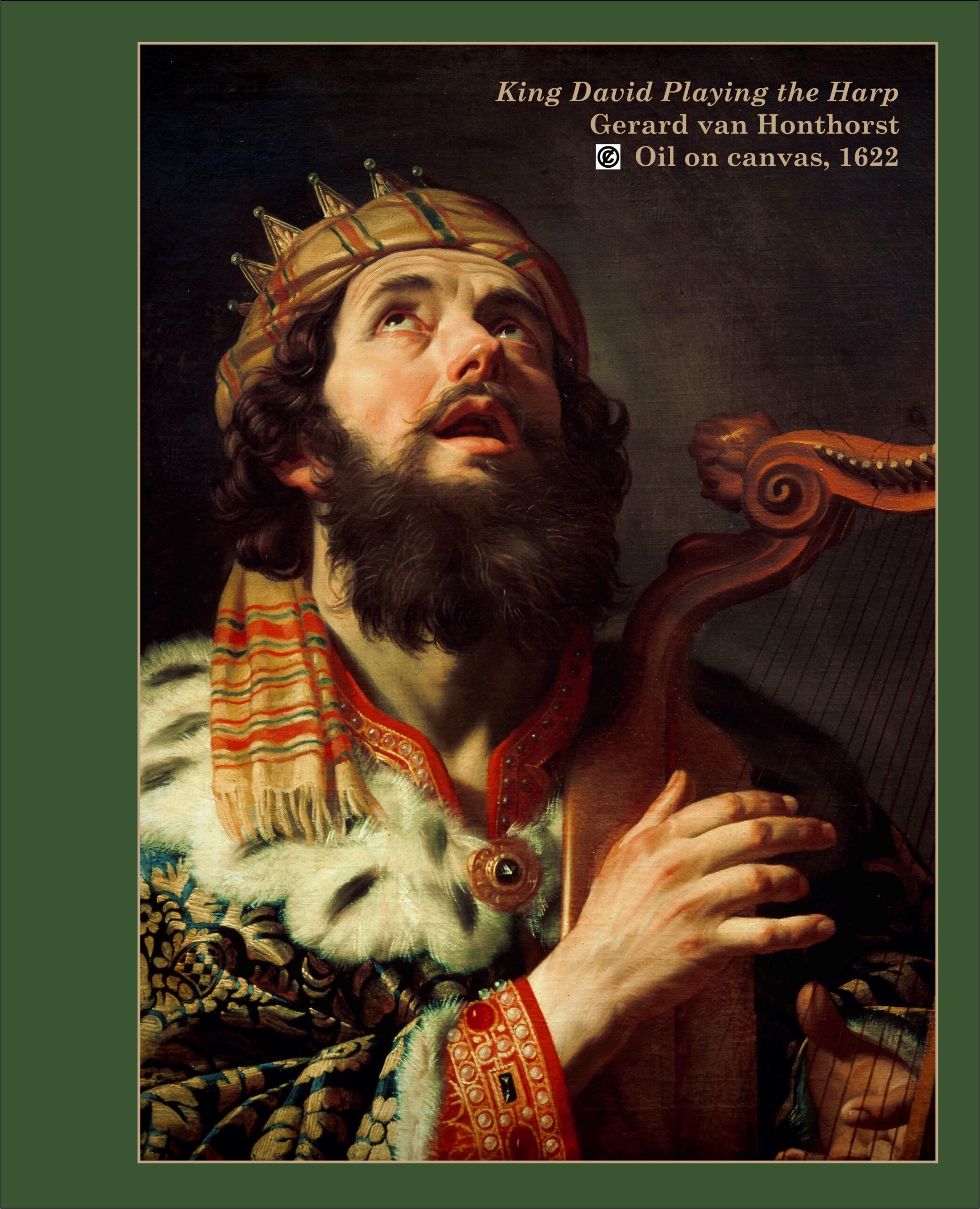

David’s beautiful and poignant psalms have blessed God’s people through the ages—teaching us essential truths about the Lord.
A very special heart
The depth of David’s reverence and love for God can clearly be described as epic. These two scriptures—one in the Old Testament and one in the New Testament—tell us everything we need to know about David.
[The prophet Samuel, speaking to King Saul:] “…But now your kingdom shall not continue. The LORD has sought for himself a man after his own heart, and the LORD has appointed him to be prince over his people, because you have not kept that which the LORD commanded you.”
1 Samuel 13:14, New Heart English Bible
When [God] had removed [King Saul], he raised up David to be their king, to whom he also testified, ‘I have found David the son of Jesse, a man after my heart, who will do all my will.’
Acts 13:22, World English Bible
The Lord Almighty himself testified about David—a man after God’s own heart.
Chosen for a unique anointing
After David was anointed king by Samuel, his second anointing took place. An anointing unlike any other in the Bible. From this post about Samson:
The Spirit of the Lord “rushing upon” someone is a remarkable thing. This wording is used three times about Samson, two times about King Saul, and once about David—after he was anointed, but before he became king. (David’s experience was unique and beyond our comprehension. It was a perpetual, ongoing rushing of the Spirit.) That’s it. Six times in the whole Bible (ESV).
The Lord gave David, a man after his own heart, a perpetual, ongoing rushing of the Spirit. The Holy Spirit empowered David spiritually and physically to do remarkable things—in service of God; in battle against man, beast and a giant; in service of his nation and the whole world. Truly remarkable.
David was chosen by the Lord.
He was the right person for essential tasks—
writing music praising the Lord,
conquering many foes in battle.
leading the nation of Israel as king
and being one of Jesus’ ancestors.
A song for David
When I was growing up, I really enjoyed singing the hymn below, “I Am Resolved.” I think it’s perfect for David—a man of earnest devotion to God.
Lord, we thank you for our brother, David—devoted and full of faith.
Wrap-up
It’s easy for us to label people based on their biggest screw-up or the darkest season of their lives. If people only knew your worst moment or reality, what would they call you? __________, the ________. I would be Frankie Ann, the murderer. And that’s all I would be. Case closed.
Thanks be to God that he looks at our hearts. As his children, our sins are removed, cast away, and we’ve been washed clean by the atoning blood of Jesus Christ, our Savior and Lord.
Being remembered
How would you like people to remember you? What would you like them to call you?
__________, the ________.
Let’s consider our three Chosen By God stories.
♦ A man who persecuted the church was chosen to build it.
♦ A woman who was unprotected was chosen to protect others.
♦ A man isolated from his family was the one man in the Old Testament chosen for a perpetual—constant—rushing of the Holy Spirit.
Will you renew or rethink who these three people were? Paul. Rahab. David.
As you move forward, what will you think of Paul? What will you call him?
Paul, the __________________.
What about Rahab? What will you call her?
Rahab, the __________________.
And what will you call David?
David, the __________________.
Getting acquainted
As for me, I sure look forward to sitting down in heaven with each one of them—Paul, Rahab and David—and hearing their stories. I really do. “Won’t It Be Wonderful There” by Dailey & Vincent celebrates our future in heaven. It is so festive. Enjoy.
Let’s seek to look at people’s hearts—asking God to give us discernment, show us the truth, and reveal any hidden things we need to know.
The subtitle of today’s post is Chosen. I hope some of these scriptures about being chosen will bless you.
Coming next
We’ll wrap up our deep dive into Colossians 1:9-14 as we explore two kingdoms. Until next time, thanks for reading and for Choosing Peace.
Closing word and song
As you listen to today’s closing instrumental song, “Sean’s Favorite” by Goldmine Pickers, reflect on one or more of our three central people today—Paul, Rahab and/or David. What did God show you? Has your heart been changed toward one of them? Close your eyes, listen quietly, and ask God to show you what he wants you to see and remember….
More
To stay current on recent posts, sign up for my monthly newsletter.