Isaac, Jacob and Joseph
Welcome back, Peaceful Readers. Let’s continue learning about the honorees in The Hall of Faith, found in Hebrews, chapter 11. So far, we’ve covered Abel, Enoch and Noah (part 1), and Abraham and Sarah (part 2 thru part 4).
From part 1:
I picture The Hall of Faith like a beautiful, ornate hall with statues or paintings lining the walls, with memorabilia or descriptions in front of each one—like a beautiful, timeless, holy museum.


Isaac—the hearer
Let’s start with Isaac’s commendation in The Hall of Faith.
By faith, Isaac blessed Jacob and Esau, even concerning things to come.
Hebrews 11:20, New Heart English Bible
They say visual impairment results in people with more acute hearing. Isaac displayed that truism in more ways than one.

The back-story
When he was old and had lost his sight, Isaac told his son Esau it was time to bestow his fatherly blessing on him, since he was Isaac and Rebekah’s firstborn son. Sadly, Jacob tricked their father and stole Esau’s blessing. Here’s more of the back-story from this post:
Isaac and Rebekah had twin boys, Jacob and Esau. Esau was born first, so he was slated to receive the greater inheritance and blessing. That’s the way things were done back then.
Reversal of blessing
Jacob wasn’t some greedy, bratty teenager when he tricked his father Isaac and stole his brother Esau’s blessing. In fact, he was more than 70 years old….
Hatcher of the plan
Jacob didn’t act alone. In fact, stealing Esau’s blessing wasn’t even his idea. [It was his mother Rebekah’s idea.]
For more details, see part 3 of The Gift of the Bible.

Eyes to see
Isaac couldn’t see who he was speaking to, but God Almighty was fully aware of what was going on. What Isaac considered to be his favorite son Esau’s blessing was actually a blessing and prophesy about Rebekah’s favorite son, Jacob. And Isaac’s blessing was right—despite Jacob’s bald-faced lie—“I am Esau your firstborn” (Genesis 27:19b, NHEB).
Jacob’s blessing
What blessing did Isaac unknowingly bestow on Jacob?
His father Isaac said to him, “Come near now, and kiss me, my son.” He came near, and kissed him. He smelled the scent of his clothing, and blessed him, and said, “Look, the scent of my son is as the scent of a field which God has blessed. God give you of the dew of the sky, of the fatness of the earth, and plenty of grain and new wine. Let peoples serve you, and nations bow down to you. Be lord over your brothers. Let your mother’s sons bow down to you. Cursed be everyone who curses you. Blessed be everyone who blesses you.”
Genesis 27:26-29, New Heart English Bible
Ears to hear
The blessing Isaac spoke over Jacob was accurate for Jacob, even though Isaac thought he was blessing Esau. Who knew Isaac’s prophetic words were meant for Jacob? God did. The Hall of Faith commemoration for Isaac states that by faith Isaac blessed his sons “concerning things to come” (v. 20b). The Holy Spirit gave Isaac the right words for the right son, even though Isaac thought he was speaking to someone else.
To a certain extent, The Hall of Faith commemoration for Isaac means that by faith, Isaac spoke the words the Holy Spirit gave him. That is a major commendation. It really is. Isaac couldn’t see, but he could hear—in an earthly way and in a spiritual way. Isaac didn’t understand what was going on at the time—and he “trembled very violently” when he realized he’d been tricked; but Isaac honored the Lord nonetheless.
Isaac heard the voice of the Holy Spirit and faithfully spoke his words.
His prophesy spoken to Jacob came true—even though Jacob was disguised as someone else. What a deep, thought-provoking event. This scene says to me, loud and clear: We can’t hide from God.
Jacob was chosen by God; Esau wasn’t. Read this article for more.

Esau’s blessing
Isaac and Esau were devastated by Jacob’s trickery. The name Jacob actually means “He takes by the heel” or “He cheats.” In Genesis 27, we learn that Esau begged his father for his blessing three times:
♦ “Bless me, even me also, my father” (v. 34c, NHEB).
♦ “Haven’t you reserved a blessing for me?” (v. 36e).
♦ “Have you but one blessing, my father? Bless me, even me also, my father.” Esau lifted up his voice, and wept (v. 38).
Isaac answered Esau, “Look, I have made him your lord, and I have made all of his brothers his servants. And I have sustained him with grain and new wine. What then can I do for you, my son?”
[Esau pleaded the third time.] Isaac his father answered him, “Look, of the fatness of the earth will be your dwelling, and of the dew of the sky from above. By your sword will you live, and you will serve your brother. It will happen, when you will break loose, that you shall shake his yoke from off your neck.”
Esau hated Jacob because of the blessing with which his father blessed him. Esau said in his heart, “The days of mourning for my father are at hand. Then I will kill my brother Jacob.”
Genesis 27:37, 39-41, New Heart English Bible
Time
The family believed Isaac would pass away soon, but they were totally mistaken. Isaac was roughly 130 years old when this presumably end-of-life Blessing Day took place. He lived to be 180 years old. Isaac lived 50 more years!
Surprisingly, Isaac blessed Jacob again as he sent him away. Rebekah told Jacob to flee to her brother’s land, saying she’d send for him to return after Esau calmed down. Rebekah had no idea that her favorite son would fall in love and would make his own life far away. His 12 sons became the patriarchs of the 12 tribes of Israel.

The timing for Blessing Day may have seemed strange, in retrospect, but everything occurred right on time. Jacob needed to move away and start his own family. And God needed to deal with him—away from his controlling mother. (See this post.)
Isaac’s blessing and prophesy over Jacob foretold the future.
And Jacob’s future, including several vital journeys,
needed to begin that very day.
And it did.
Yes—Isaac and Esau were devastated by what Jacob did; but his departure was essential for his own life story, his sanctification and future generations. Did Jacob’s departure also serve other members of his family? Yes. Discover Rebekah’s consequences in this post.
Formed and informed
Sometimes a very painful event or chapter of our lives teaches us many things. One that comes to my mind is our stillborn son, Joshua. What a shocking experience. Afterwards, I went to a new doctor. Unusual medical tests revealed that I have a rarely-diagnosed blood clotting disorder. And late last year, more than 20 years later, that medical information changed the way things were handled for my two surgeries. Did the Lord save my life through this tragedy? I believe he did.
I was formed by our loss—softened and strengthened. That may sound like a strange combination of outcomes, but I needed both. Holding our dead baby in my arms made me more compassionate to others. Joshua’s death broke my heart—but more importantly, it softened my heart. In time, I finished grieving his death and laid my sorrow down. This experience strengthened me by deepening my faith as I leaned in close to Jesus—before, during and after. The loss strengthened my perseverance and helped me write the Grieving series years later.
I was formed in important ways—changed for the better—by Joshua’s death. I was also informed. The Lord gave me vital medical information I needed for my future. All glory to God.
Your turn
Grab your journal or a piece of paper and spend a little time reflecting on your life. Can you think of a tragic or devastating event or season that formed you and possibly informed you about something you needed to know? What event or season comes to mind? How did it change you? What did you learn about yourself? About God? About something or someone else?
Pray and thank God for building you, spiritually, and for his love, presence and care.
Jacob—the traveler
Before his journeys began, Jacob lied about his identity to his blind father and stole his brother’s blessing. After that, he took a long spiritual journey. God Almighty brought Jacob close to him, and revealed himself to Jacob in many ways. Due to a severe famine—and major twists and turns in his own family—Jacob spent the final segment of his long life in Egypt.
The blessings
At the end of his life, Jacob spoke blessings and prophesies over his 12 sons, and the Bible tells us he spoke rightly. Like his father Isaac, Jacob spoke the words of blessing and prophesy given to him by the Lord—some good things, some bad things.
When Joseph and his two sons met privately with Grandpa Jacob, the patriarch also spoke blessings over Joseph’s two sons. Here’s Jacob’s commendation in The Hall of Faith:
By faith, Jacob, when he was dying, blessed each of the sons of Joseph, and bowed down over the top of his staff.
Hebrews 11:21, New Heart English Bible
Jacob’s heart for God
From part 15 of The Gift of the Bible:
Notice the interesting twist in how Jacob (AKA Israel) blessed Joseph’s two sons. Joseph seated his oldest, Manasseh, on Israel’s right, so the highest blessing would go to the oldest. “This is the way it’s done.” But Jacob crossed his arms intentionally, and put his right hand on the head of Ephraim, the youngest.
Then he blessed Joseph, and said, “The God before whom my fathers Abraham and Isaac walked, the God who has been my shepherd all my life to this day, the Angel who has redeemed me from all evil, bless the boys. And may my name be carried on in them, and the names of my fathers Abraham and Isaac. And may they grow into a multitude upon the earth.”
Genesis 48:15-16, New Heart English Bible
Even though Israel asked God to “bless the boys,” the Bible tells us that this was a blessing on Joseph, their father. I don’t really understand that, and that’s okay. I love how Israel (1) described the faithfulness of his father and grandfather, (2) acknowledged God as his lifelong shepherd, (3) gave credit for protection and sanctification to “the Angel”—the Holy Spirit, (4) requested the carrying on of the names Abraham, Isaac and Jacob, and (5) echoed God’s promise—that Joseph’s sons would grow into a large nation. What a beautiful blessing.

Like his father Isaac, Jacob spoke the words
of blessing and prophesy given to him by the Lord.
(Our pastor explained what I didn’t understand in the Bible passage above in the sermon, “Blessing and Consequence.” Start at 5:37.)
Jacob received a great blessing and he passed on great blessings—with the guidance of the Holy Spirit.
Joseph—the believer
Let’s conclude today’s Hall of Faith commendations with Joseph—Jacob’s favorite son.
By faith, Joseph, when his end was near, made mention of the departure of the children of Israel [from Egypt]; and gave instructions concerning his bones.
Hebrews 11:22, New Heart English Bible
The longest set of posts on Choosing Peace, called The Gift of the Bible, covered the epic life of Joseph in 18 parts. If you missed it, start reading it soon!
Peaceful Readers, based on all the remarkable aspects of Joseph’s life, what do you make of his commendation? Read it a second time.
The Lord’s covenant with his people
What a revealing commendation. Joseph was honored for his belief in the Lord’s covenant. That’s why I titled this section Joseph—the Believer. Egypt was not their home. God Almighty would give them The Promised Land. And Joseph knew he needed to be laid to rest there—with his ancestors—with his people.
So Joseph lived in Egypt, he, and his father’s household. And Joseph lived one hundred ten years. Joseph saw Ephraim’s descendants to the third generation. The children also of Makir, the son of Manasseh, were counted as Joseph’s own. And Joseph said to his brothers, “I am about to die, but God will surely take care of you and bring you up out of this land to the land which he promised to Abraham, to Isaac, and to Jacob.” Then Joseph made the sons of Israel take an oath, saying, “God will surely take care of you. Then you must carry up my bones from here.” So Joseph died, being one hundred ten years old, and they embalmed him and placed him in a coffin in Egypt.
Genesis 50:22-26, New Heart English Bible
Joseph’s deep faith
Joseph didn’t only believe in the Lord’s covenant with the nation of Israel. He knew God personally—his nature, his faithfulness, his power, his protection, his provision. That’s why he said twice in the passage above: “God will surely take care of you.” Read the Reverent Submission section in this post to drink in Joseph’s deep, abiding belief in God Almighty.
Joseph trusted God implicitly.
Fulfilling The oath
Did Joseph’s brothers honor their oath to carry his bones from Egypt to their family resting place? The brothers who hated him? The brothers who plotted his death, and then opted to sell him into slavery? The brothers who lied to their father and broke his heart? The brothers who kept their awful secret for years? Surprisingly, yes. They honored their oath. (Joseph’s brother Judah became a true believer. Praise the Lord! And Jesus came from the line of Judah.)
Joseph’s brothers passed down their oath to future generations. And those generations passed down the oath, faithfully. I find that truly remarkable. Do you know any words of your great-great-great-great-great-great-great… grandfather—passed down through generations?
More than 400 years after Joseph’s brothers took their oath, Moses took Joseph’s bones with the nation of Israel when God rescued them from slavery in Egypt. Then they wandered for 40 years in the wilderness—until they were ready to enter The Promised Land.
The Israelites carried Joseph’s bones with them
every day for 40 years in the wilderness.
That is truly remarkable.
We learn about Joseph’s final resting place at the end of the book of Joshua.
From our ancestors
We can have a hard time appreciating the impact our ancestors have had on our lives—our location, habits, words, songs, beliefs, abilities, hobbies, the things that matter to us, our appearance, health, our relationship with God, and so much more.
Many people have literally nothing passed down to them from even their grandparents. No objects. No diaries. No writings. Very few photos, if any. Things about you may have come from your great-great-great grandmother or grandfather—or someone even further back. One of your common facial expressions. One of your unique sayings. That little ditty you just sang in the car. Those silly, made-up words you say. That nickname you gave someone special. Will you ask God to reveal something to you in this area, if it would bless you? Something about you that was passed down from those who came before you—even if you or your parents were adopted?
Your lineage or heritage isn’t only about biology. You have a familial heritage. And you have a spiritual heritage. They may or may not overlap.
Let me share a very interesting story with you.
Our tribe
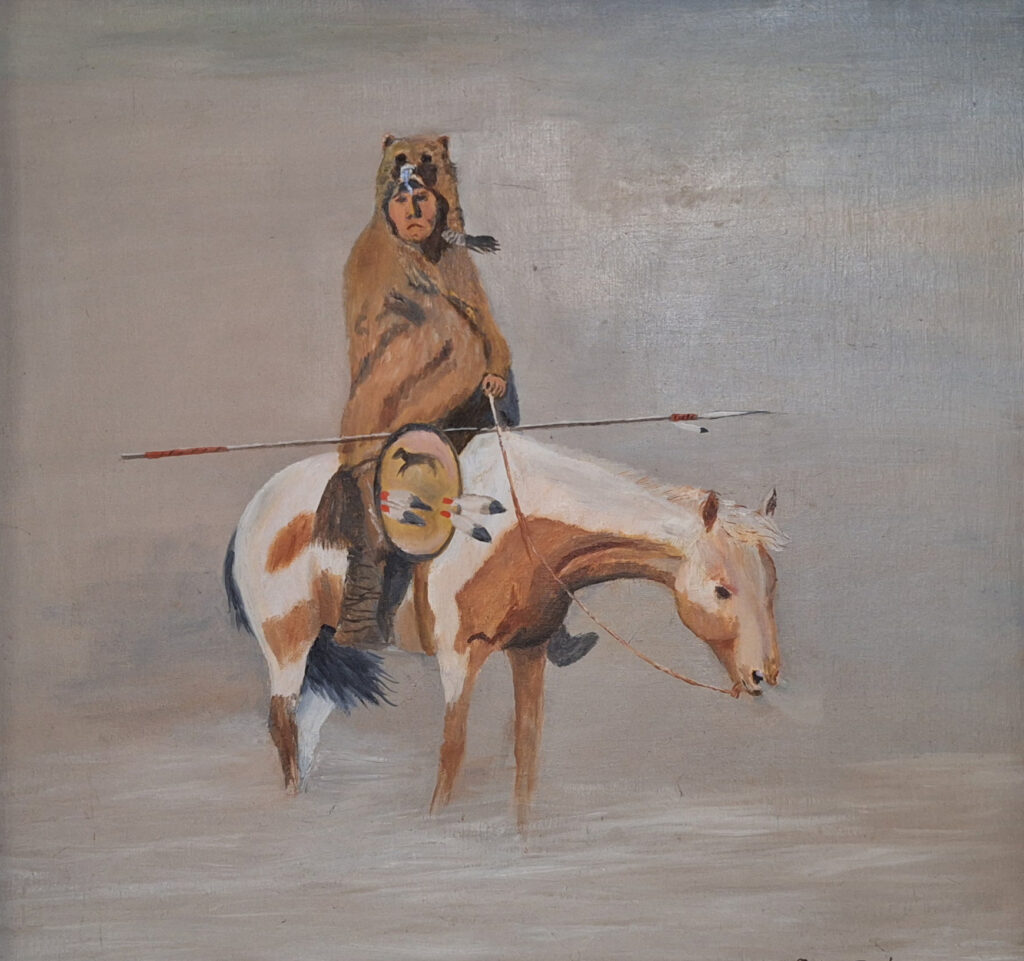
My paternal grandfather was quite a character. I’ll call him Gramps. He worked for the forestry service as a surveyor and traveled a lot, living in tents when he was working. He married my grandmother, an American Indian from the Choctaw tribe. He loved American Indians and often painted them. Grandma was adopted by a couple in Kansas. I never met her. She died when my dad was 19 years old.
My whole life, Gramps, Grandma, my dad and our whole family believed that story. Then I got a DNA analysis from Ancestry.com six years ago. I have no American Indian DNA whatsoever. I am 15% African—mostly from Nigeria, which explains my dad’s dark skin and extremely tight, curly hair. You see, Grandma wasn’t American Indian. She was biracial, born in 1901—a time when biracial babies were rejected by the white community and the black community. But they were embraced and raised in the American Indian community.
The American Indian ancestor our son Logan saw vividly in a vision tells us about our familial heritage, not our biological heritage. Even though we don’t share DNA with the Choctaw nation, they comprise an important part of our family heritage because they adopted and raised Grandma. Thanks be to God! (Maybe I’ll tell you sometime about our wonderful visit to the Choctaw Labor Day Festival, including the church service.)
Resemblance
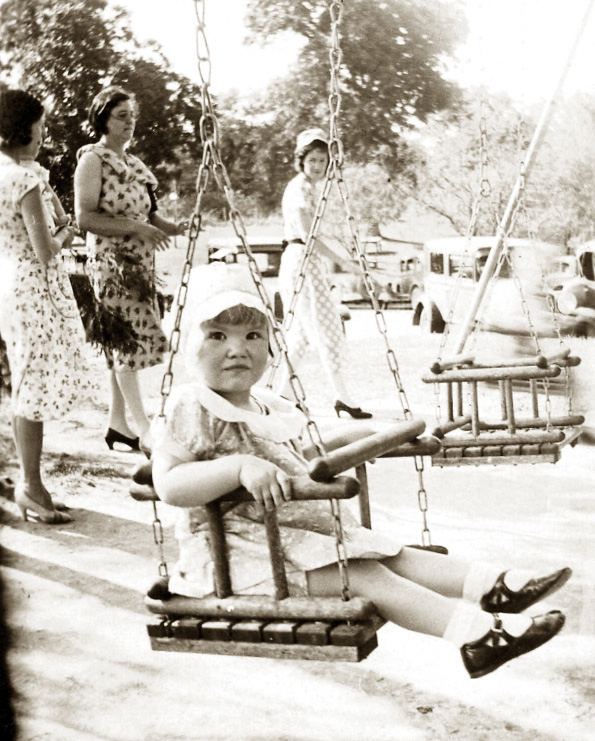
Let’s close with another heritage story. The other day, my friend Meagan mentioned the old photo featured in a recent post (shown below). She saw my resemblance to my mom in this photo—taken when Mom was about two years old. I was very surprised because everyone has commented my whole life about how much I look like my dad. But it got me thinking…. And smiling.
Your heritage
Do you have a heritage story—biological, familial, spiritual or other—that you can share with someone special in your life? Your heritage has a valuable purpose, even if generations or segments were very dark and difficult. Past chains—generational curses—can be broken, with God’s help. And blessings can be passed down and shared with others.
Resources and a prayer
For more on these subjects, go to Christian Living in the index, and scroll to this listing: Generational curses, sins and blessings. Three posts are available there for you.
Lord, bless my Peaceful Readers and their loved ones with spiritual flourishing and an ever-closer relationship with Jesus Christ. Amen!
Coming next
The next honorees in The Hall of Faith will be Moses and his parents. I’m excited about what the Lord has in store for us.
Thanks for reading and for Choosing Peace.
Closing word and song
“ONE THREE NINE (Psalm 139)” by Aubrey Logan
Newsletter
To stay current on recent posts, sign up for my monthly newsletter.