Dedicated to Noelle, a beacon of kindness
The Lord fights for Judah
Today’s post is infused with songs by Aaron Shust, including old favorites and new-to-me gems. I hope you’re richly blessed by his music. So many different sounds and styles. I especially appreciate his devotion to God’s word.
Faithfulness
The title of the hymn we sang at our wedding, “Great Is Thy Faithfulness,” comes from well-known verses in Lamentations. So does this 2021 song.
For more about God’s faithfulness, experience the many surprises of The Mirror, part 4, dedicated to my friend Elyse.

Coming today
So far in this post, Before and After, we’ve explored some amazing events recorded in the book of Daniel, in chronological order. In part 1, we covered the Before Event—the writing on the wall. Then, in part 2, we covered The Main Event—Daniel and the lions’ den, followed by the After Event—Daniel’s prayer.
Today we’ll start with one of my 12 favorite Bible stories—The Main Event. Have you ever heard of the story when the Lord fought for Judah, whose enemies had gathered for battle against them? This remarkable Bible story doesn’t get as much attention as Gideon or the walls of Jericho tumbling down in the days of Joshua—both of which made the cut for VeggieTales, Sunday school and Vacation Bible School.
Peaceful Readers, I think you’ll love this never-heard-of or frequently-forgotten story. This event took place after the days of King David and King Solomon, and before the prophet Elisha, and the epic stories of Jonah and Daniel. Get ready to read about car rides, a bunny, and the Valley of Blessing.

Seeking the Lord
Fierce enemies
Chapter 20 in the book of Second Chronicles begins with fierce enemies on the move against God’s people. The Moabites, Ammonites and some of the Meunites were coming for battle against Jehoshaphat, king of Judah, the southern kingdom. (Israel was the northern kingdom.)
How did King Jehoshaphat respond when he heard that “a great multitude” was coming?
Jehoshaphat was alarmed, and set himself to seek… the LORD. He proclaimed a fast throughout all Judah. Judah gathered themselves together, to seek help from the LORD. They came out of all the cities of Judah to seek the LORD.
2 Chronicles 20:3-4, New Heart English Bible
The king declared: “We will fast as a people.” They desperately needed to focus their hearts and minds on God. The attack was coming—soon.
Assembling for one purpose
The words Judah and seek… the Lord are used three times in the two short verses above. From this post: “Words are repeated in the Bible for special emphasis.” The king and his people didn’t stay home or spread themselves hither and yon in solitary prayer. They assembled as one in the Lord’s temple at Jerusalem with one purpose—to urgently seek God’s help.
All Judah stood before the LORD, with their little ones, their wives, and their children.
2 Chronicles 20:13, New Heart English Bible
Everyone came—from the oldest to newborn babes, from the lowest to the highest, from the strongest to the weakest. Parents, older siblings and grandparents held the little ones. Can we even begin to imagine such a gathering or their fear? Three armies were coming for them. And they knew the Ammonites were brutal.
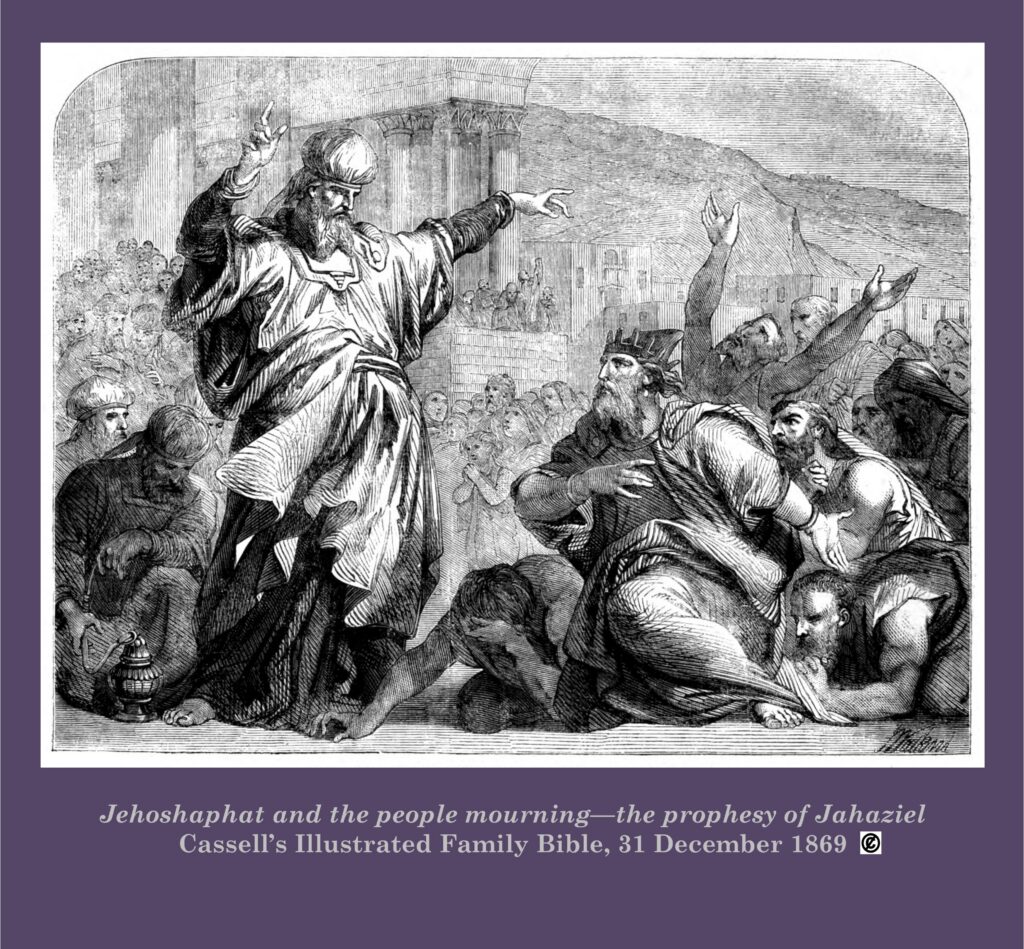
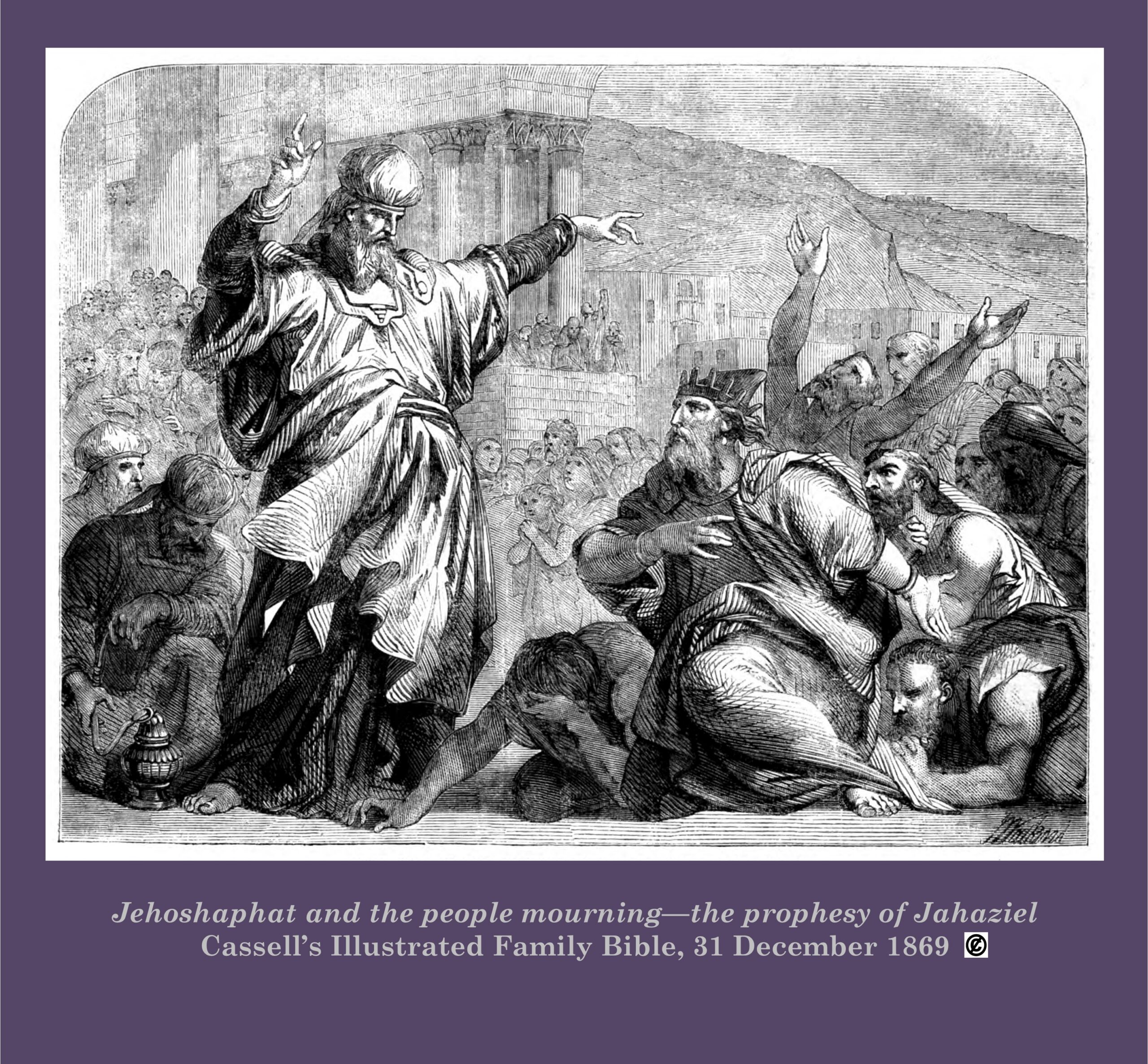
All the people of Judah stood in the temple
to urgently seek God’s help.
A song—the Lord’s help
Listen to this rich adaptation of Psalm 121. You’ll feel like you stepped across the ocean to Jerusalem.
The king’s prayer
Part 1—filled with faith
King Jehoshaphat stood in the temple and called out to the Lord for his people:
“O LORD, the God of our fathers, aren’t you God in heaven? Aren’t you ruler over all the kingdoms of the nations? Power and might are in your hand, so that no one is able to withstand you. Did you not, our God, drive out the inhabitants of this land before your people Israel, and give it forever to the descendants of Abraham your friend? They lived in it, and have built you a sanctuary in it for your name, saying, ‘If evil comes on us—the sword, judgment, pestilence, or famine—we will stand before this house, and before you, (for your name is in this house), and cry to you in our affliction, and you will hear and save.’”
2 Chronicles 20:6-9, New Heart English Bible
Do you hear the king’s deep faith in his prayer? Glory, hallelujah! King Jehoshaphat knew God—his identity, his authority, his power, his presence, and his mighty acts—what the Lord had done through the ages for his people. What a wonderful testimony of faith.
Let’s focus on one phrase from this part of the king’s prayer: “For your name is in this house (v. 9).”
A song—the Lord’s name
Enjoy the glorious images in the video of this reggae-styled song.
Part 2—desperate need
In part 1 of his prayer, the king focused on God’s identity, power and covenant relationship with his people. In part 2, he lays out their history with the approaching enemies and their desperate situation.
“Now, look, the people of Ammon and Moab and Mount Seir, whom you would not let Israel invade, when they came out of the land of Egypt, but they turned aside from them, and did not destroy them; look, how they reward us, to come to cast us out of your possession, which you have given us to inherit. Our God, will you not judge them? For we have no might against this great company that comes against us….”
2 Chronicles 20:10-12a, New Heart English Bible
King Jehoshaphat ended his prayer with absolute humility:
“We don’t know what to do, but our eyes are on you.”
2 Chronicles 20:12b, World English Bible
What a beautiful prayer.
A song in desperate times
I think of this song as “King Jehoshaphat’s Song”—filled with both desperation and faith; and, most of all—trusting in the Lord.
Your turn
Does the end of King Jehoshaphat’s prayer sound familiar? “We don’t know what to do, but our eyes are on you” ~ 2 Chronicles 20:12b, NHEB.
Get out your journal or a piece of paper and reflect on these questions. Can you remember a time when you had something serious going on or coming your way, and you didn’t know what to do? Did you ask God for help? What happened? Did things turn out the way you expected? Worse? Better? Did the situation last shorter or longer than you thought it would? How were you changed? Did you encounter God during that season? If so, how? Let me ask this one again: How were you changed?
To read about a time when I didn’t know what to do, see this post from the Forgiving series.
A song of peace
Are you in a difficult situation, Peaceful Reader? Do you know someone who is? A loved one or friend? An acquaintance? A colleague? A neighbor? A relative? Someone you just met or encountered? Listen quietly to this wonderful song and share it with someone. Ask God to show you who needs to hear “Peace Be Still.”
God’s response
Right after King Jehoshaphat’s prayer, the Spirit of the Lord—the Holy Spirit—came on one of the Levites, Jahaziel, and gave him the Lord’s answer:
“Listen, all Judah, and you inhabitants of Jerusalem, and you king Jehoshaphat. Thus says the LORD to you, ‘Do not be afraid, neither be dismayed by reason of this great multitude; for the battle is not yours, but God’s.’”
2 Chronicles 20:15, New Heart English Bible
Jahaziel, empowered by the Holy Spirit, told them to go down to the battlefield against their enemies, detailing where they’d be found the following day.
“You will not need to fight this battle. Set yourselves, stand still, and see the salvation of the LORD with you, O Judah and Jerusalem. Do not be afraid, nor be dismayed. Go out against them tomorrow, for the LORD is with you.’”
2 Chronicles 20:17, New Heart English Bible
God said it, and he meant it. Set yourselves. Stand still. See the Lord’s salvation. Go out. And remember: “The Lord is with you.”

A song of confidence
Frankie Ann’s favorite
When I listened to the next song the other day, Logan talked about how I played it frequently in the car during his childhood. That made me smile. There’s not a better song for him to remember from Car Rides with Mom. I shoot my hand up high when I hear the chorus of “My Savior My God”—my all-time favorite Christian song written during my lifetime.
About the artist
Who is singer-songwriter Aaron Shust? This excellent 13-minute video reveals his heart. Learn about the song “My Savior My God,” his visits to Israel, Aaron and his wife’s newborn son who needed open-heart surgery, the blessings of their son with special needs, and more.
Yes, I’ve warned my Peaceful Readers about evil within the Christian music industry. Aaron Shust owns his own music label, so he’s free from certain corporate entanglements. (Additional comments in More at the end.)
Let’s return to King Jehoshaphat and the people of Judah.
The people’s response
How did the people of Judah respond to the Lord saying he’d fight this battle for them?
Jehoshaphat bowed his head with his face to the ground; and all Judah and the inhabitants of Jerusalem fell down before the LORD, worshipping the LORD. The Levites… [—who were responsible for the temple and worship—] stood up to praise the LORD, the God of Israel, with an exceeding loud voice.
2 Chronicles 20:18-19a, c, New Heart English Bible
After God responded to King Jehoshaphat’s prayer, the Levites stood up and sang loud praises to the Lord. How do you think their singing impacted the people? The people of Judah were surrounded by boisterous, harmonious, glorious singing. I wonder if it felt like God himself was singing over them—blanketing them in his assurance, wrapping them in his arms, reminding them of his power.
Can you remember a time when the Lord delivered you or someone you love from something or someone or someplace—maybe from a very hard season? How did you respond? Did you pray? Did you praise God by singing? Did you laugh? Did you cry? Did you flop down in exhaustion? Did you sit quietly in awe? Did you shout?
When we told our life group at church about Logan’s salvation, I stood up and twirled in circles. I danced.
A song of assurance
Let the truth of Jesus’ supremacy wash over you as you listen to “Savior of the World.”
The Lord fights for Judah
Faith, preaching and singing
Drink in the details of this miraculous day.
They rose early in the morning, and went forth into the wilderness of Tekoa: and as they went forth, Jehoshaphat stood and said, “Listen to me, Judah, and you inhabitants of Jerusalem. Believe in the LORD your God, so you will be established. Believe his prophets, and you will prosper.” When he had taken counsel with the people, he appointed those who should sing to the LORD, and give praise in holy array, as they went out before the army, and say, “Give thanks to the LORD; for his loving kindness endures forever.”
2 Chronicles 20:20-21, New Heart English Bible
After telling his people to listen, King Jehoshaphat preached the essential message of faith:
“Believe in the Lord your God….”
2 Chronicles 20:20c, New Heart English Bible
The singers were dressed in beautiful, holy splendor. The singers walked in front of the army of Judah. The singers were the front line!
A song of faith
Be a part of the front line today by singing. Join in with Aaron Shust, his band and the people, and sing with them: “You’re all I need.”
The battle
Notice the chain of events in this powerful scene.
When they began to sing and to praise, the LORD set ambushers against the people of Ammon, Moab, and Mount Seir, who had come against Judah; and they were struck. For the people of Ammon and Moab stood up against the inhabitants of Mount Seir, utterly to kill and destroy them: and when they had made an end of the inhabitants of Seir, everyone helped to destroy another. When Judah came to the place overlooking the wilderness, they looked at the multitude; and look, they were dead bodies fallen to the earth, and there were none who escaped.
2 Chronicles 20:22-24, New Heart English Bible (emphasis added)
Three armies united to attack Judah—God’s people.
When the nation of Judah arrived, their enemies were all dead.
The power of worship
And this miraculous scene began when the singers, dressed “in holy array,” began to sing and praise God as they walked toward the battlefield.
The day before, they were told:
“Listen, all Judah, and you inhabitants of Jerusalem, and you king Jehoshaphat. Thus says the LORD to you, ‘Do not be afraid, neither be dismayed by reason of this great multitude; for the battle is not yours, but God’s.’”
2 Chronicles 20:15, New Heart English Bible
They didn’t know how the Lord would fight the battle for them, but they knew this: God said it, and he meant it.
We see the power and beauty of worship
in this remarkable two-day event.
The people of God coming together.
Faith. Prayer. Singing. Preaching.
The presence and power of God Almighty.
A song of praise
It’s praise time! Sing along with “Ever Be.”
The Lord’s provision and protection
You will dig this part.
When Jehoshaphat and his people came to take their spoil, they found among them in abundance both riches and dead bodies, and precious jewels, which they stripped off for themselves, more than they could carry away: and they were three days in taking the spoil, it was so much. On the fourth day they assembled themselves in the Valley of Berachah; for there they blessed the LORD….
2 Chronicles 20:25-26a, New Heart English Bible
While the people of Judah spent three days taking the spoils of war, the Lord provided for them and protected them in multiple ways. To our knowledge, the people weren’t injured by the many swords, spears, shields, sharp armor or other weapons on the battlefield, in tents or storage areas. They weren’t bothered by wolves, lions or birds feasting on the dead men’s flesh. They came back and forth for three days, gathering everything they could.
And the Lord was with them.
A song of protection
Psalm 91, The Protection Psalm, is a personal favorite. (For more, explore Psalm 91 under The Bible in the index or see the book, Psalm 91, on this Resources page.) Enjoy this happy song by Aaron Shust.
The connection between provision and protection
One thing we often fail to recognize is the intrinsic relationship between provision and protection.
When the Lord provides us with the basics, he’s protecting us from poverty. When the Lord provides us with food, he’s protecting us from hunger and starvation. When the Lord provides us with clean water, he’s protecting us from thirst, disease and poor hygiene. When the Lord provides us with shelter, he’s protecting us from the elements and from being victims of crime. When the Lord provides us with clothing, he’s protecting us from illness, injury and rejection. When the Lord provides us with strength and balance, he’s protecting us from falling down. When the Lord provides us with caring loved ones, he’s protecting us from loneliness.
Can you think of some other examples?
When the Lord provides us with _______, he’s protecting us from _______.
When the Lord provides us with _______, he’s protecting us from _______.
When the Lord provides us with _______, he’s protecting us from _______.
A song that paints a picture
Peaceful Readers, the world is dark, but God shines on his children. Be blessed by this song.
When the Lord provides us with light, he’s protecting us from the darkness.
Vast, luxurious spoils
Back to 2 Chronicles 20. As far as provisions are concerned, God’s people were overwhelmed by the spoils, including precious jewels—“more than they could carry away” (v. 25). What warriors or special forces come into battle wearing jewels? The ones devoted to destruction by God Almighty for the good of his people. The Lord—our powerful God—influenced each Moabite, Ammonite and Meunite soldier on what to wear and what to bring.
What kinds of spoils did the people of Judah recover in addition to “riches… and precious jewels” (v. 25, NHEB)? In other Bible translations, we find:
♦ “goods, clothing” (ESV)
♦ “equipment” (NIV)
♦ “cattle… and other valuables” (CEB)
♦ “supplies” (GNT)
♦ “money, garments” (TLB)
Are you starting to envision the vastness of the spoils from these three armies—described as a “great multitude”? The wagons, the livestock, the food, the water and wine, the weapons and battle gear, the supplies, the spare clothing, the musical instruments, the tents, the furniture, the hammocks, the lamps, etc.? Plus, the abundant jewels? Plus, the gold and silver coins and other cash? Wow—to say the least.
Why?
In verse 11, King Jehoshaphat prays about how the approaching armies plan to drive them out of the land God gave them. Perhaps the confident Moabite, Ammonite and Meunite armies brought their moving vans packed to the max, so to speak. Perhaps they were so confident of victory that they brought a profuse number of items and riches to set up house in their new digs in downtown Jerusalem or at a nearby villa in the country. The senior officers would get first pick. They had it all figured out. Or so they thought.
Our loving God did everything for the good of his people. He protected them before, during and after the battle he fought for them. And he gifted them with profuse, overwhelming, lavish physical provision of all types—delivered to them by their enemies.
The Lord poured out his lavish protection
and provision on all the people of Judah.
A song—God’s greatness
When I listen to “No One Higher,” I smile and smile and smile some more.
Other types of provision
Spiritual provisions
It may sound bizarre to think about lavish provisions being delivered to people by their enemies, but this is what God can do—in more ways than one. We think of provisions in material ways, but we desperately need spiritual provisions—the virtues of life. Faith. Wisdom. Discernment. Courage. Strength. And many more. (For a list of virtues and their corresponding vices, see The Inner State section of this post.)
When various relatives attacked us, the Lord gave us knowledge and discernment. When various relatives poured chaos all around us, the Lord gave us clarity and peace. When various relatives lobbed grenades at our house (via manifestos and sneak attacks), the Lord gave us courage and perseverance. (For details, explore Letters or Violence in the index.)
Have you experienced the Lord’s spiritual provision through an enemy? Did God build you spiritually through someone’s attack, sabotage, chaos, theft or control? Through someone’s evil? Through something or someone else? Rest in this truth:
And we know that all things work together for good for those who love God, to those who are called according to his purpose.
Romans 8:28, New Heart English Bible
Think on these things. And thank the Lord for his spiritual provision in your life!
Emotional provisions

When I say emotional provisions, I’m referring to things that fill our emotional cup, so to speak—undoubtedly good things. Our emotional provisions can come from many sources—a loved one, a smile, a hug, wholesome things that make us laugh, nature, music, art, the Bible, great books, a heartwarming story/book, etc. This year, I’m reading Jan Karon’s Mitford series for the fourth time. I’m on book 10—Home to Holly Springs. These books are filled with wonderful, heartwarming stories, humor, scriptures and quotes. Highly recommended.
Our emotional provisions can also come from our pets. Rosie (shown above) is such a snuggle bunny. Her love and joy are wonderful parts of each and every day. Thanks be to God.
A song of renewal
What an important song. How do the truths in “You Redeem” speak into your story?
Thanksgiving
Let’s travel to the Valley of Berachah—the Valley of Blessing.
Valley of blessing
On the fourth day—after three days of taking the spoils from their enemies—the people of Judah assembled in the Valley of Blessing and blessed the Lord. They came together with grateful hearts, praising the Lord, Most High who’d poured out such mighty protection and abundant provision on their nation.
Victory
I wrote about gathering the spoils in the Grieving series:
Who shall separate us from the love of Christ? Could oppression, or anguish, or persecution, or famine, or nakedness, or peril, or sword? No, in all these things, we are more than conquerors through him who loved us.
Romans 8:35 and 37, World English Bible
What does a conqueror do? A conqueror takes the spoils—packs up the goodies (i.e., my enemy’s valuable stuff)—and heads home. A conqueror celebrates. A conqueror leaves the battle behind and is victorious.
For more about experiencing victory after an extremely difficult season, read this post.
A song to praise, thank and bless the Lord
This delightful adaptation of Psalm 103 details God’s faithful, tangible love for us.
Worship, protection and peace
How did these events end for the nation of Judah?
They came to Jerusalem with stringed instruments and harps and trumpets to the house of the LORD. The fear of God was on all the kingdoms of the countries, when they heard that the LORD fought against the enemies of Israel. So the realm of Jehoshaphat was quiet; for his God gave him rest all around.
2 Chronicles 20:28-30, New Heart English Bible
The people sang and worshipped God in the temple. All the other kingdoms heard what God had done, so the nation of Judah lived in peace for many years.
All glory to God!
A song of rest
What does it mean to rest in the Lord? Reflect on the truths in this song.
Gratitude
Thank you for listening to the songs in today’s unusual post. Let me know your thoughts.
Thank you, Aaron Shust, for your music
and your devotion to the Lord and his word.
You’ve blessed us richly.
Don’t miss the closing song below. I think you’ll love it.
Coming next
We’ll cover the Before Event and After Event surrounding today’s story. You’ll be surprised. Until then, thanks for reading, listening and for Choosing Peace.
Closing word and song—combined
More
Peaceful Readers, if you’d like to know more about Aaron Shust, review this NAR Connections article—a dissenting view. While I don’t perceive doctrinal concerns in his music, we know that our associations, partnerships and influences do matter. Let’s proceed with prayer and discernment in all our media choices—our listening, watching and reading. As for me, I woke up the other day singing Aaron Shust’s “Majestic”—the closing song—in my head. I was thankful, I smiled, and I kept on singing it.
To stay current on recent posts, sign up for my monthly newsletter.
Thank you for this post! I especially liked: “When the Lord provides us with the basics, he’s protecting us from poverty. When the Lord provides us with food, he’s protecting us from hunger and starvation. When the Lord provides us with clean water, he’s protecting us from thirst, disease and poor hygiene. When the Lord provides us with shelter, he’s protecting us from the elements and from being victims of crime. When the Lord provides us with clothing, he’s protecting us from illness, injury and rejection. When the Lord provides us with strength and balance, he’s protecting us from falling down. When the Lord provides us with caring loved ones, he’s protecting us from loneliness.”
Great reminders that He fights for us, cares for us and is intrinsically involved in our lives.
You’re so welcome, Jennifer! Thanks very much for your thoughts.