Moses—the prophet
Have you ever encountered a particular Bible verse multiple times in a short period of time—knowing the Holy Spirit was emphasizing it for you?

Repeat verse
As I drove through Fort Worth to my writing retreat this weekend, I saw “Be still, and know that I am God” on a large church sign along Interstate 30. A couple days earlier, I wrote a card to someone. The scripture on the front said: “Be still, and know that I am God.” And here I am, watching a beautiful sunrise through the large bank of windows in a lovely guest house outside Weatherford. And the word to me is:
“Be still, and know that I am God….”
Psalm 46:10a, New Heart English Bible

With leaves dancing on the tree, I gazed at pink, purple, blue and pale yellow in the sky. Glorious. And I drank it in. I was still—and I gave glory to my magnificent God.
Then I said my favorite Bible verse out loud:
Great is the Lord, and greatly to be praised;
and his greatness is unsearchable.
Psalm 145:3, King James Version
Peaceful Reader, how will you be still today and know that he is God?

Favorites
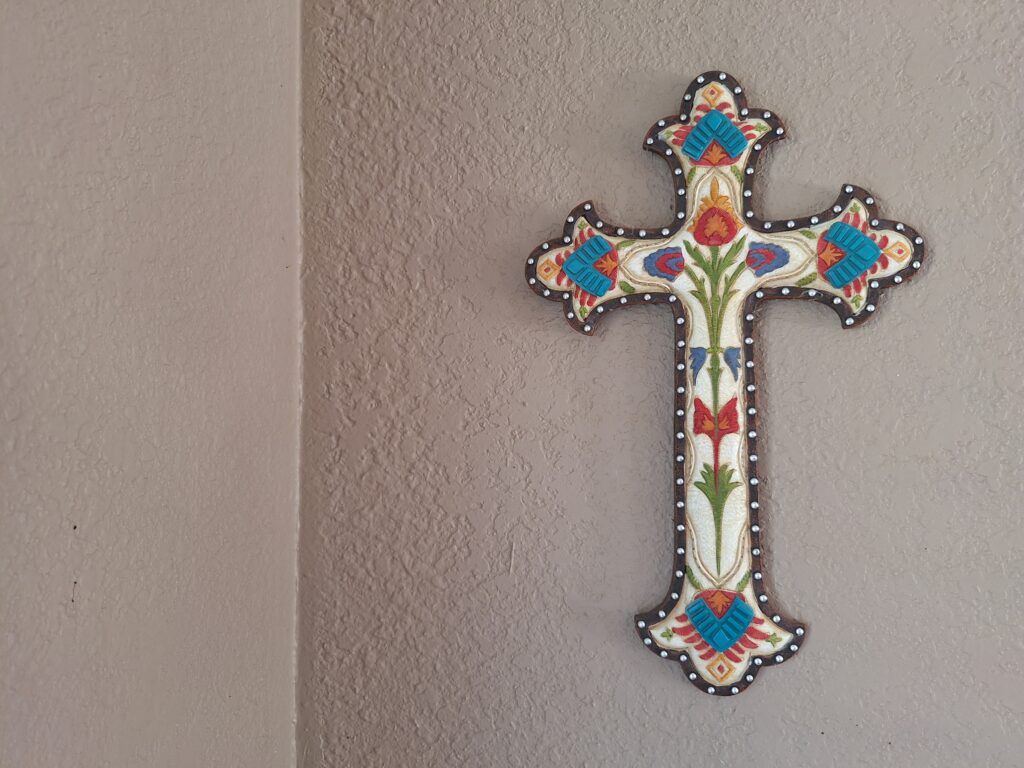
The Lord is blessing me richly with favorite things during this third writing retreat. Flowers. A candle. Antiques. Chocolate. Rain. Cold weather. A fuzzy blanket. Crosses on the wall. Favorite foods. Silence. I hope you’re blessed by the retreat photos scattered through this post. A heartfelt shout-out to Martha, my amazing Airbnb host. I texted my friend Sam, “I feel like I’m in God’s garden! Incredible.”

As you stroll through today’s post, ask yourself this question: “Does this photo remind me of one of my favorite things?”
Thank the Lord for his goodness—his very personal goodness to you.
When I woke up from a nap—also a favorite—this song flowed through my mind. Enjoy “Rising Sun” by All Sons & Daughters. We sang it in church recently.
Recap
Last time on Choosing Peace, we learned about Moses’ parents and the extreme measures they took to save his life, given the murderous order of Pharaoh, king of Egypt. Even though they weren’t named in Exodus 2 or in Hebrews 11—The Hall of Faith chapter, Moses’ parents were appropriately recognized and honored in The Hall of Faith. I called them Chuck and Melanie. (Last week, I found their real names. They were relatives. Read the Wife vs. Sister section in part 3 to learn why this was commonplace and permitted at the time—until the declaration of God’s purity laws.)
From part 6:
I know in my heart that Chuck and Melanie prayed earnestly and faithfully for Moses—before his birth, after his birth, and after he was delivered to the palace—knowing that they gave him to a princess whose father ordered his murder. Moses would be raised as a grandson to the mighty and murderous Pharaoh. How would he be treated? What remarks or nicknames would swirl around him in the palace? What dangers would he face? What evil? What false teaching?
After Chuck and Melanie delivered Moses to the princess—daughter of Pharaoh, the next scene in Exodus 2 shows Moses as an adult.
The murder
One day, Moses decided to go and see how his people, the Israelites, were being treated. He saw an Egyptian striking a Hebrew slave. Moses murdered the Egyptian and buried him in the sand.
He went out the second day, and look, two men of the Hebrews were fighting with each other. He said to him who did the wrong, “Why do you strike your fellow?” He said, “Who made you a prince and a judge over us? Do you plan to kill me, as you killed the Egyptian yesterday?” Moses was afraid, and said, “Surely this thing is known.”
Exodus 2:13-14, New Heart English Bible
Prince and judge
Check out the foreshadowing. “Who made you a prince and a judge over us?” (v. 14a). God Almighty did. Moses was raised in the palace, according to the Lord’s will. And—little did Mr. Smart Mouth know—but one day, Moses would shepherd, lead and pronounce judgments over the nation of Israel. God made Moses a prince and a judge. Not simultaneously, but a prince and a judge nonetheless.
The monumental men
One day in our life group, I mentioned that a number of God’s monumental men in the Bible committed murder, including Moses, King David and Paul. I said it’s important for the Bible to counter people’s natural presumption that goes like this: “No one in the Bible ever did anything as bad as I did. God couldn’t want or love me.” We need to acknowledge that grave and violent sins don’t disqualify us from being loved and chosen by the Lord, experiencing a close and deep relationship with the Lord, and accomplishing impactful things for the Lord and his kingdom.
The blood of Jesus Christ covers all kinds of sins for all the true believers—called, chosen and adopted into the family of God.
Let’s return to Moses’ story.
New life—and the mission
Word of the murder reached Pharaoh.
Now when Pharaoh heard this thing, he sought to kill Moses. But Moses fled from the face of Pharaoh, and lived in the land of Midian….
Exodus 2:15a-c, New Heart English Bible
After his first-recorded journey out of Egypt, Moses met and married his wife Zipporah in Midian and began his own family. After that, Pharaoh died, so his son would’ve been crowned. (Moses knew the new Pharaoh as his uncle, since Moses was raised by the old Pharaoh’s daughter—a princess of Egypt.)
Later, Moses was commissioned by God Almighty to lead the massive nation of Israel out of Egypt in what we call The Exodus.
There has not arisen a prophet since in Israel like Moses, whom the LORD knew face to face, in all the signs and the wonders, which the LORD sent him to do in the land of Egypt, to Pharaoh, and to all his servants, and to all his land, and in all the mighty hand, and in all the great terror, which Moses worked in the sight of all Israel.
Deuteronomy 34:10-12, New Heart English Bible
For more about Moses and the Israelites, explore these three posts:
♦ Manna from Heaven (part 9 of Before and After)
♦ Water from the Rock (part 10)
♦ War with the Amalekites (part 11)

The hall of faith
Moses—the prophet, part 1
As you read this first segment of Moses’ commendation in The Hall of Faith, what stands out to you?
By faith, Moses, when he had grown up, refused to be called the son of Pharaoh’s daughter, choosing rather to share ill treatment with God’s people, than to enjoy the pleasures of sin for a time; considering the abuse suffered for the Christ greater riches than the treasures of Egypt; for he looked to the reward [of heaven]. By faith, he left Egypt, not fearing the wrath of the king; for he endured, as seeing him who is invisible.
Hebrews 11:24-27, New Heart English Bible
Moses chose God over money. He chose God over pleasure. He chose God’s people over the wealthy, powerful Egyptians. Moses considered suffering for Jesus to be “greater riches than the treasures of Egypt” (v. 26).

This reality jumped out at me.
Moses—a great and mighty prophet—knew Jesus was coming.
He knew he was suffering for being a follower of Christ.
That totally blows my mind. I’m sitting still—knowing that he is God.
Ponder Jesus’ eternal nature as God’s Son in this important passage from John, chapter 1.
Jesus
The Apostle Peter spoke these words, recorded in Acts 3:
For Moses indeed said to the fathers, ‘The Lord your God will raise up a prophet for you from among your brothers, like me. You must listen to him in all things whatever he says to you. It will be, that every soul that will not listen to that prophet will be utterly destroyed from among the people.’
Acts 3:22-23, New Heart English Bible
The writer of Hebrews described how Jesus is greater than Moses. In this passage, Jesus chastised the Jewish religious leaders for believing in Moses, who prophesied about him, but refusing to believe Jesus himself, who was speaking to them and working miracle after miracle.
Heaven
The commendation about Moses includes his anticipation of eternity in heaven. We find this common theme about a number of the honorees in The Hall of Faith. Abel, Enoch and Noah (see part 1), plus Abraham and Sarah were all commended thusly:
These all died in faith, not having received the promises, but having seen them and embraced them from afar, and having acknowledged that they were foreigners and temporary residents on the earth. For those who say such things make it clear that they are seeking a country of their own. If indeed they had been thinking of that country from which they went out, they would have had enough time to return. Instead, they were longing for a better country, that is, a heavenly one. Therefore God is not ashamed of them, to be called their God, for he has prepared a city for them.
Hebrews 11:13-16, New Heart English Bible
How does that passage about heaven impact you? What do you envision? Hope for? Think about?
I look forward to all of it—what I’ll see, hear and feel; who I’ll see and embrace; worshiping God and singing; seeing Jesus face-to-face; the flowers, the feasting, my heavenly home; and so much more…. Read Imagine Heaven by John Burke, one of my favorite books described on this resources page. Highly recommended.

Faith over fear
Let’s briefly reflect on the last sentence from the commendation segment featured above.
By faith, [Moses] left Egypt, not fearing the wrath of the king; for he endured, as seeing him who is invisible.
Hebrews 11:27, New Heart English Bible
After murdering the Egyptian, Moses didn’t fear Pharaoh, who wanted him dead and commanded a massive army. That’s a bold statement of faith. Moses left Egypt, knowing that the Lord was leading him. Moses endured and persevered as he traveled, as though he saw God ahead of him, leading the way—“as seeing him who is invisible.”
That reminds me of when Jesus said to his disciples: “Follow me.”
Journeys
We’ve all taken journeys. Some were forced on us, like when our families moved when we were children. From this post:
When I was in Kindergarten, we moved to Georgia late at night. When I woke up the next morning, I didn’t know where I was. I laid in my bed for what felt like a very long time, because I was afraid to get up. Where was I? Where would I go? Where were my parents? I could not call for [them], because I wasn’t supposed to ask for help. Asking for help was bad. Where was the bathroom? Where was I? How did I get here? I felt like I was in outer space.
After I eventually got up, I wandered around this strange place until I found someone I recognized.
As we can all testify, journeys come in many different shapes and sizes. Some are disorienting, like a childhood move late at night. Getting married is always a big journey. (See this post about Abraham and Sarah.)

At times, we’ve chosen to take other big journeys, not really knowing what was coming—a move, a career change, a divorce, etc. Some journeys—like surgery, a serious injury or a long illness—may come unexpectedly or suddenly. Late last year, I had two major surgeries. This year, I’ve taken The Journey to Strength—challenging, but incredibly worthwhile. Other times, our journeys are blissful, like my writing retreat.
We take many journeys. Many, many journeys. Some are physical journeys. Others are emotional and/or spiritual journeys. (Read about The Healing Journey here on Choosing Peace.)
Your turn
Get out your journal or a piece of paper and make notes as you reflect on one of your stories. When have you left somewhere, not knowing exactly what was coming next, yet knowing you were heading in the right direction? What and/or who were you leaving? What did you experience on your journey? What memorable or important stops occurred on your way? How did you experience God’s encouragement or presence? What natural consequences did you experience? What did you learn as you traveled forward? What support or criticism did you encounter from others? Did a particular word, message or Bible verse punctuate this season in your life? What other memories come to mind from this season or journey?
Pray to God about that journey—whatever you’d like to say.

Moses—the prophet, part 2
The second segment of Moses’ commendation in The Hall of Faith involves the nation of Israel.
By faith, [Moses] kept the Passover, and the sprinkling of the blood, that the destroyer of the firstborn should not touch them.
Hebrews 11:28, New Heart English Bible
The Passover, the tenth plague and The Exodus
The Lord gave Moses and Aaron detailed instructions on how to observe the Passover. Then Moses taught the elders of Israel. Compliance meant life or death, and many steps were involved. Painting the lamb’s blood on their doorposts kept the Lord from striking down their firstborn. The Lord’s people obeyed.
It happened at midnight, that the LORD struck all the firstborn in the land of Egypt, from the firstborn of Pharaoh who sat on his throne to the firstborn of the captive who was in the dungeon; and all the firstborn of livestock. Pharaoh rose up in the night, he, and all his servants, and all the Egyptians; and there was a great cry in Egypt, for there was not a house where there was not one dead. He called for Moses and Aaron by night, and said, “Rise up, get out from among my people, both you and the children of Israel; and go, serve the LORD, as you have said. Take both your flocks and your herds, as you have said, and be gone; and bless me also.”
The Egyptians were urgent with the people, to send them out of the land in haste, for they said, “We are all dead men.”
Exodus 12:29-33, New Heart English Bible
The people of Israel obeyed the Passover requirements, not understanding the ramifications. They had no idea that the Egyptians would urgently ask them to leave the day after their first Passover. Their 430 years in slavery were suddenly complete. They were free, technically-speaking, but they experienced great difficulty adapting to life in the wilderness. (Details in this post.)

Moses—the number, the blessing and the prayer
Forty
The number forty stands out in Moses’ life, and is detailed in Stephen’s epic speech before he was martyred. Moses lived in Egypt for 40 years before fleeing to Midian. He lived there 40 years before hearing from God through the burning bush. After the children of Israel left Egypt, Moses led them for 40 years as they wandered in the wilderness before being ready to enter The Promised Land.
To explore the importance of certain numbers in the Bible—and the number 10 in my life—read part 6 of Before and After. It’s fascinating.
The final blessing
Right before he died, Moses blessed the nation of Israel. His final blessing ended like this:
“There is none like God, Jeshurun, who rides on the heavens for your help, in his majesty through the skies. The eternal God is your dwelling place. Underneath are the everlasting arms. He thrust out the enemy from before you, and said, ‘Destroy.’ Israel dwells in safety; the fountain of Jacob alone, in a land of grain and new wine. Yes, his heavens drop down dew. You are happy, Israel. Who is like you, a people saved by the LORD, the shield of your help, the sword of your excellency. Your enemies shall submit themselves to you. You shall tread on their high places.”
Deuteronomy 33:26-29, New Heart English Bible
This photo reminds me of “his majesty through the skies” in the scripture above.

The prayer
Psalm 90, a prayer written by Moses, vividly displays his reverence and awe of God, Most High. Consider your answer to this question as you read Moses’ prayer below.
Do we soft-pedal or completely ignore
the reality of God’s wrath and judgment?
Psalm 90
A Prayer by Moses, the man of God.
Lord, you have been our dwelling place for all generations. Before the mountains were brought forth, before you had formed the earth and the world, even from everlasting to everlasting, you are God.
You turn man to destruction, saying, “Return, you descendants of Adam.” For a thousand years in your sight are just like yesterday when it is past, like a watch in the night.
You sweep them away as they sleep. In the morning they sprout like new grass. In the morning it sprouts and springs up. By evening, it is withered and dry.
For we are consumed in your anger. We are troubled in your wrath. You have set our iniquities before you, our secret sins in the light of your presence.
For all our days have passed away in your wrath. We bring our years to an end as a sigh. The days of our years are seventy, or even by reason of strength eighty years; yet their pride is but labor and sorrow, for it passes quickly, and we fly away. Who knows the power of your anger, your wrath according to the fear that is due to you?
So teach us to number our days, that we may gain a heart of wisdom. Relent, LORD. How long? Have compassion on your servants. Satisfy us in the morning with your loving kindness, that we may rejoice and be glad all our days. Make us glad for as many days as you have afflicted us, for as many years as we have seen evil. Let your work appear to your servants; your glory to their children. Let the favor of the LORD our God be on us; establish the work of our hands for us; yes, establish the work of our hands.
Psalm 90, New Heart English Bible

Moses heard and saw the Lord’s wrath in Egypt and in the wilderness, again and again. He clearly understood God’s wrath as an essential part of his eternal, just and loving nature.
Wrath against the ungodly
is part justice and part protection.
When the Lord drowned the Egyptian army in the Red Sea, he demonstrated justice toward them and protection toward the Israelites.
The Lord’s discipline
Moses also saw God’s wrath against the sins of those whose hearts belonged to him—in his sister Miriam’s life, his brother Aaron’s life and his own life.
For more details, see these articles:
♦ Who was Moses in the Bible?
♦ Who was Aaron in the Bible?
♦ Who was Miriam in the Bible?
When and how have you experienced the Lord’s discipline? Close your eyes and take some time to see what sin, event, season or relationship the Lord brings to your mind.
For the moment all discipline seems painful rather than pleasant;
later it yields the peaceful fruit of righteousness
to those who have been trained by it.
Hebrews 12:11, Revised Standard Version*
*Revised Standard Version of the Bible, copyright © 1946, 1952, and 1971 the Division of Christian Education of the National Council of the Churches of Christ in the United States of America. Used by permission. All rights reserved.
See the whole passage about discipline here.
The song of Moses and the Lamb—Jesus
Let’s end today’s post with a beautiful song by Moses and Jesus, recorded for us in Revelation.
I saw something like a sea of glass mixed with fire, and those who overcame the beast, his image, and the number of his name, standing on the sea of glass, having harps of God. They sang the song of Moses, the servant of God, and the song of the Lamb, saying,
“Great and marvelous are your works, Lord God Almighty. Righteous and true are your ways, King of the nations. Who would not fear you, Lord, and glorify your name? For you only are holy. For all the nations will come and worship before you. For your righteous acts have been revealed.”
Revelation 15:2-4, New Heart English Bible
Amen and hallelujah!
Coming next
The next honorees in The Hall of Faith will be the Israelites. I’m excited about what the Lord has in store for us.
Thanks for reading and for Choosing Peace.
Closing word and song
“Be still, and know that I am God….”
Psalm 46:10a, New Heart English Bible
“Concerto grosso in G Minor, Op. 6 No. 8 “Christmas Concerto” ~ VI. Largo, Pastorale” by Arcangelo Corelli
Newsletter
To stay current on recent posts, sign up for my monthly newsletter.