Manna from heaven
Good day to you, Peaceful Reader. Welcome back.
Part 8 opened with a list of what we’ve covered so far in Before and After. Each group of posts contains three key topics: The Main Event, the Before Event and the After Event, followed by the interesting things we learn from all three events. Group 3 contained Jesus Healing the Ten Lepers and two Master Classes by Jesus himself: Unworthy Servants and The Second Coming.
Join me as we begin Group 4 by journeying back into the Old Testament. For the first time, we’ll be exploring important slices of The Exodus. I can’t tell you how excited I am. Today’s focus will be on the Before Event—bread literally raining down from the hand of God.
While I’m not Miss Fancy in the kitchen, I do enjoy simple baking. You won’t find me using yeast or kneading dough. Being a quick bread gal gives me more time for writing—and gives us some delicious goodies, to boot. Yee-haw.

Get ready to read about steak and potatoes, a peanut butter and jelly sandwich, and Buc-ee’s.

The back-story
In the 18-part post called The Gift of the Bible, we explored the remarkable life of Joseph. If you missed it or need a refresher, I highly recommend moving it to the top of your To-Read List.
Birth of a nation
Twelve brothers, including Joseph, became the patriarchs of the twelve tribes of Israel. After Joseph and his generation died, a new pharaoh ruled Egypt. He didn’t know who Joseph was or what he’d done—saving many nations from starvation during a devastating seven-year famine and serving as second in command over Egypt.
From foreigners to slaves to wanderers
While living in Egypt, the Israelites multiplied greatly and the Egyptians were afraid of them. The new pharaoh made them slaves. For 400 years, the Israelites were slaves in a foreign land, just as the Lord foretold to their ancestor Abraham.
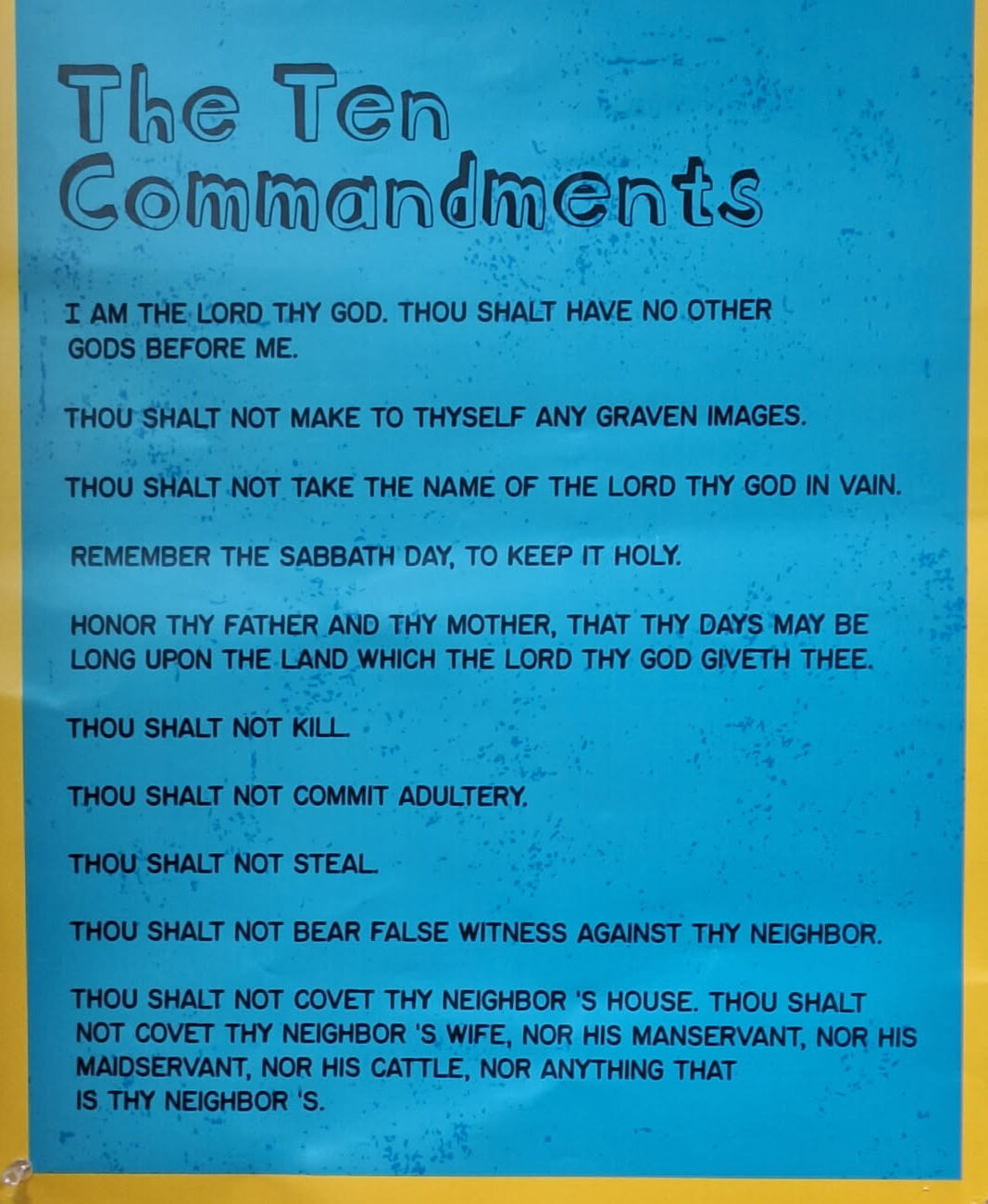 The Lord raised up Moses, the initially-reluctant leader of the Israelites—gifted by God as a prophet, who (1) told Pharaoh repeatedly to “Let my people go,” (2) led the Israelites out of Egypt and for 40 years of wandering in the desert, and (3) walked closely with God—who spoke directly to Moses, gave him power to work miracles, and gave him The Ten Commandments written by God on stone tablets.
The Ten Commandments
Did you know that The Ten Commandments now hang in Texas public school classrooms? Can you believe it? Hallelujah! Read part 5 to learn about the State Board of Education meeting my pal Charlene and I attended this summer. It was most enlightening.
Let’s dig into one key aspect of the back-story: The Israelites’ rescue from slavery in Egypt.
The Exodus
God Almighty demonstrated his power in delivering the nation of Israel from slavery with miracle upon miracle.
♦ The plagues.
♦ The Angel of Death.
♦ Pharaoh’s shocking, long-sought permission.
♦ The Egyptians giving the Israelites gold, silver and clothing.
♦ The Israelites walking across the Red Sea on dry ground.
♦ The waters falling upon the Egyptian army and drowning them.
Released—or not
Slavery is usually a brutal existence. Watch this six-minute video about today’s Christian slaves in Pakistani brick kilns. Like the Israelites, their children are born into slavery. For real stories from slaves in the 1800s, dig into this post and this post.
When the Israelites left Egypt, their release from slavery was completed. Or was it?
Ruthless taskmasters
How hard was life in Egypt for the Israelites?
And the Egyptians ruthlessly made the children of Israel labor, and they made their lives bitter with hard labor, in mortar and in brick, and in all manner of labor in the field, all their labors which they ruthlessly made them do.
Exodus 1:13-14, New Heart English Bible
The word ruthlessly is used twice in these verses for emphasis. The Egyptian taskmasters were cruel. Harsh. Unrelenting. Relaxation? No. Reasonable expectations? No. A peaceful life? No. A vacation? No. Hopes and plans for the future? No.
The Egyptians made life bitter for the Israelites “with hard labor.”
Digging more deeply
As we explore part of the Israelites’ story while they wandered in the desert, we can naturally find ourselves thinking of them as epic whiners. As I’ve dug more deeply into Exodus, chapter 16, I’ve found myself thinking differently about them. I hope you’ll find yourself challenged too.
While we can sympathize with the Israelites’ hardships as slaves, we can’t really comprehend the severity of their experiences—the oppression and control; the inability to come and go at will; the physical and emotional strain; the poverty; the degrading, cruel remarks; the sound of cracking whips; the injuries—seen and unseen. The people of Israel likely had nightmares featuring their cruel taskmasters.
And they saw no way out.
Hearts and minds
When Mom and Dad are weary, fearful and frustrated—persistently oppressed by powerful outside forces—their words and emotions reflect that reality. What would it be like to be parented by slaves? To be raised from birth as a slave? To work as a slave? To believe that you’d die as a slave? Close your eyes and think about your answers to those questions.
For many generations—400-plus years—the nation of Israel lived in daily exhaustion, dread and frustration. Even after their rescue from slavery, their hearts and minds remained the same—weary, fearful, frustrated. Their thoughts centered on hardship and want. They kept thinking and saying the things they thought and said in Egypt.
Unknowingly, the Israelites were now slaves to something new—
something they didn’t understand—
something they couldn’t see—
something called equilibrium.
Learn about this important reality in Questions and Answers, part 2. You’ll come to understand why our hearts and minds remain the same even after our environment drastically changes.
A long road
Getting a new address, so to speak, doesn’t erase the mental, emotional and social realities of lifelong abuse, neglect and trauma. While the scenery may change, our hearts and minds are the same. We’re the same. The fear and anger don’t magically disappear. The memories, the denial, the spinning thoughts remain.
God rejoices to help us solve these problems, but it’s usually a long, winding road. See Trauma in the index and learn about The Healing Journey.

For freedom Christ has set us free;
stand fast therefore, and do not
submit again to a yoke of slavery.
Galatians 5:1, Revised Standard Version*
*Revised Standard Version of the Bible, copyright © 1946, 1952, and 1971 the Division of Christian Education of the National Council of the Churches of Christ in the United States of America. Used by permission. All rights reserved.

The before event
Moses led the nation of Israel—many thousands of people—as they wandered in the wilderness.
Let’s begin exploring the Before Event, which took place during the second month after they left Egypt.
The whole congregation of the children of Israel murmured against Moses and against [his brother] Aaron in the wilderness; and the children of Israel said to them, “We wish that we had died by the hand of the LORD in the land of Egypt, when we sat by the meat pots, when we ate our fill of bread, for you have brought us out into this wilderness, to kill this whole assembly with hunger.”
Exodus 16:2-3, New Heart English Bible
Drama and discontent
I don’t know if you’ve ever had a large group of people bad-mouthing you. I, personally, can’t imagine thousands of people complaining to and about me. And “the children of Israel” complained with fervor. “We wish God had killed us in Egypt. You brought us out here to kill us.” Drama, drama, drama. Never mind the miracle and blessings the Lord had just poured out on them—turning bitter water into sweet water and giving them refreshment under trees near twelve springs.
What was going on here? Did the Israelites have memory problems? Nope. Did they have issues with authority figures? Perhaps. Didn’t they trust the Lord? Not sure, to be honest. Peaceful Readers, what was going on?
A new normal
First, the children of Israel were forced to transition from having a set place to live to being nomads—frequently on the move, not really knowing where they were going. Moving, moving again and ever moving. I can’t imagine having to frequently pack up and move, especially with children. I’d be whining too. They were new at this, so they weren’t particularly good at it and they certainly weren’t used to it. Besides, they didn’t have any air conditioning or modern conveniences. No clean restrooms. No coolers full of snacks and fresh fruit. No Buc-ee’s up ahead. Just sand, heat and thousands of smelly people trudging forward into the unknown. Honestly, I can’t imagine how hard it was. Truly.
Group think and equilibrium
Second, they were surrounded by people who were complaining. Discontent spreads like wildfire. Beware when you hear: “Everybody thinks…,” “Everybody says…” or “Everybody knows….” Group think can be very dangerous. We saw that during COVID, didn’t we? And dissenting voices can be met with great hostility and even violence. Groups large and small can quickly fracture into Us vs. Them camps.
Third, they were experiencing the power of equilibrium—being enslaved by their old thoughts and feelings. Fear. Frustration. Despair. Hopelessness. Anger. Mistrust. Shame. Regret. Unforgiveness. Disbelief. Each person had a resting emotional state—where their thoughts and emotions hovered on a “normal” day. And their resting emotional state was based on their experiences as slaves (and their relationship with God). See this post for more.
Rewriting history
Fourth, some of the Israelites were clearly rewriting history. “Life was so great and filled with abundance in Egypt. Steak and potatoes. The comfort. The unmitigated bliss.” Why were they doing that? Why were they lying?
We could call their behavior exaggerating or telling Tall Tales, but it’s more than that. Let’s consider some of the reasons for this particular flavor of lying, called rewriting history.
Buyer’s remorse
When they were slaves, most of the people of Israel probably requested their freedom habitually. They talked about it, wished for it, prayed about it. Some of them got down on their knees and begged God to release them. Some raised their fists in anger at their horrible lot in life.
Freedom was their #1 desire.
It probably never crossed their minds how difficult the next chapter of their lives would be. Wandering in the desert wasn’t remotely what they had in mind. When we think of the word freedom, we think of peace and comfort. R&R. Happy days. And the Israelites didn’t get any of that. They got Hardship 2.0—sand in their mouths and eyes, children crying, and persistent instability.
Nowadays, we’d call this reason for lying about Egypt by its modern name: Buyer’s Remorse. In other words, “I wished and asked for this my whole life. Now that I have ‘my freedom,’ it’s a disaster. I don’t want it. Give me what I had before. At least I understood my life and had a stable place to live.” Or the short version: “No thanks. Take me back.”
And the rewriting of history sounds like this: “It wasn’t that bad.”
Shock and denial
“Surely this isn’t happening. Tomorrow I’m going to wake up and I’ll be back in Egypt. That would be so much better.” And then tomorrow comes and Hardship 2.0 slaps them in their faces—again.
And the rewriting of history sounds like this: “It wasn’t that bad.”
Troublemaking or ‘stirring the pot’
 Yes, troublemakers are an unfortunate reality, and lying is their calling card. Sowing discontent and ruining people’s lives are just a couple of the things that give them a cheap thrill. Someone’s misery is their entertainment. Nowadays, one in 25 persons is a sociopath. I’m not sure about the statistics back then, but there were plenty of bad seeds documented from Genesis onward.
And the rewriting of history sounds like this: “It wasn’t that bad.”
A bona fide troublemaker—like a spider spinning her web—would add lots of embellishment. “I remember the time when….” “My master was so funny.” “I miss so-and-so.” “Let’s tell Moses to take us back.” “He’s doing a terrible job.” Yadda, yadda, yadda. And their cancerous lies spread like wildfire. “Miss Arachnid told me about the wonderful birthday party her master threw for her. Can’t we go back? It wasn’t that bad.”
Manna from heaven
How did God Almighty, our loving Father, respond to the dramatic discontent of the children of Israel?
Then said the LORD to Moses, “Look, I will rain bread from heaven for you, and the people shall go out and gather a day’s portion every day, that I may test them, whether they will walk in my law, or not.”
Exodus 16:4, New Heart English Bible
An essential gift from God—bread from heaven—gave him the opportunity to test and strengthen the Israelites.
Rules, section 1
The Lord provided rules about the bread from heaven:
♦ Gather only enough for today.
♦ Do not keep any for tomorrow.
Would the Israelites obey? Would they learn to trust God, their provider?
The children of Israel did so, and gathered some more, some less. When they measured it…, he who gathered much had nothing left over, and he who gathered little had no lack. They gathered every man according to his eating. Moses said to them, “Let no one leave [any] of it until the morning.” Notwithstanding they did not listen to Moses, but some of them left [some] of it until the morning, and it bred worms, and became foul: and Moses was angry with them. They gathered it morning by morning, everyone according to his eating. When the sun grew hot, it melted.
Exodus 16:17-21, New Heart English Bible
Compliance or consequences
After seeing what God did to the Egyptian army, I might not have pushed the rules—particularly not so soon after leaving Egypt. Then again, maybe I would have.
Talk about immediate consequences. “I said ‘don’t do it!’ Your leftovers will be gross, filled with worms and smelly.” I’m hoping no one broke this rule more than once.
Scheming and chaos
Come to think of it, I could see certain people I know doing something like this to punish or toy with someone else. “Thanks for having us over for dinner last night. I forgot to throw away my leftovers.” Right, you little weasel. That’s why you hid your leftovers out of sight. Worms. A disgusting mess. The stench. Translation: “Enjoy the memorable parting gift from Your Friendly Neighborhood Sociopath (or some other flavor of personality disorder).”
Have you met someone like that? The backhanded compliments, the gossip, the humiliation, the chaos, the drama. The lies. I’m reminded of my evil mother-in-law, the sociopath and narcissist. I’m rolling my eyes and shaking my head—a two-for-one yet again. Leaving the sociopathic War Zone made us free at last. But we had to do the work of grieving and much more on The Healing Journey. Walk through the home page, including the lists of the posts in each series, especially Series 1: Sociopaths, Series 2: Grieving and Series 3: Forgiving.
Does the Lord have something for you to dig into on Choosing Peace? Do you have any unfinished relational, emotional or spiritual business?

Sweet daily bread
What was manna like?
When the dew that lay had gone, look, on the surface of the wilderness was a small round thing, small as the frost on the ground. When the children of Israel saw it, they said one to another, “What is it?” For they did not know what it was. Moses said to them, “It is the bread which the LORD has given you to eat….”
The house of Israel called its name Manna, and it was like coriander seed, white; and its taste was like wafers with honey.
Exodus 16:14-15 and 31, New Heart English Bible
The Lord rained manna down on his children to feed them in the wilderness. They had to gather it and make it into bread. Were they thankful? I believe many of them were. What a relief!
I love the description of manna’s taste: “like wafers with honey.” That makes me think of graham crackers or vanilla wafers. The Lord could’ve given them something sour like pumpernickel, but he chose to give them something sweet. I love that.
Oh taste and see that the LORD is good.
Psalm 34:8a, New Heart English Bible
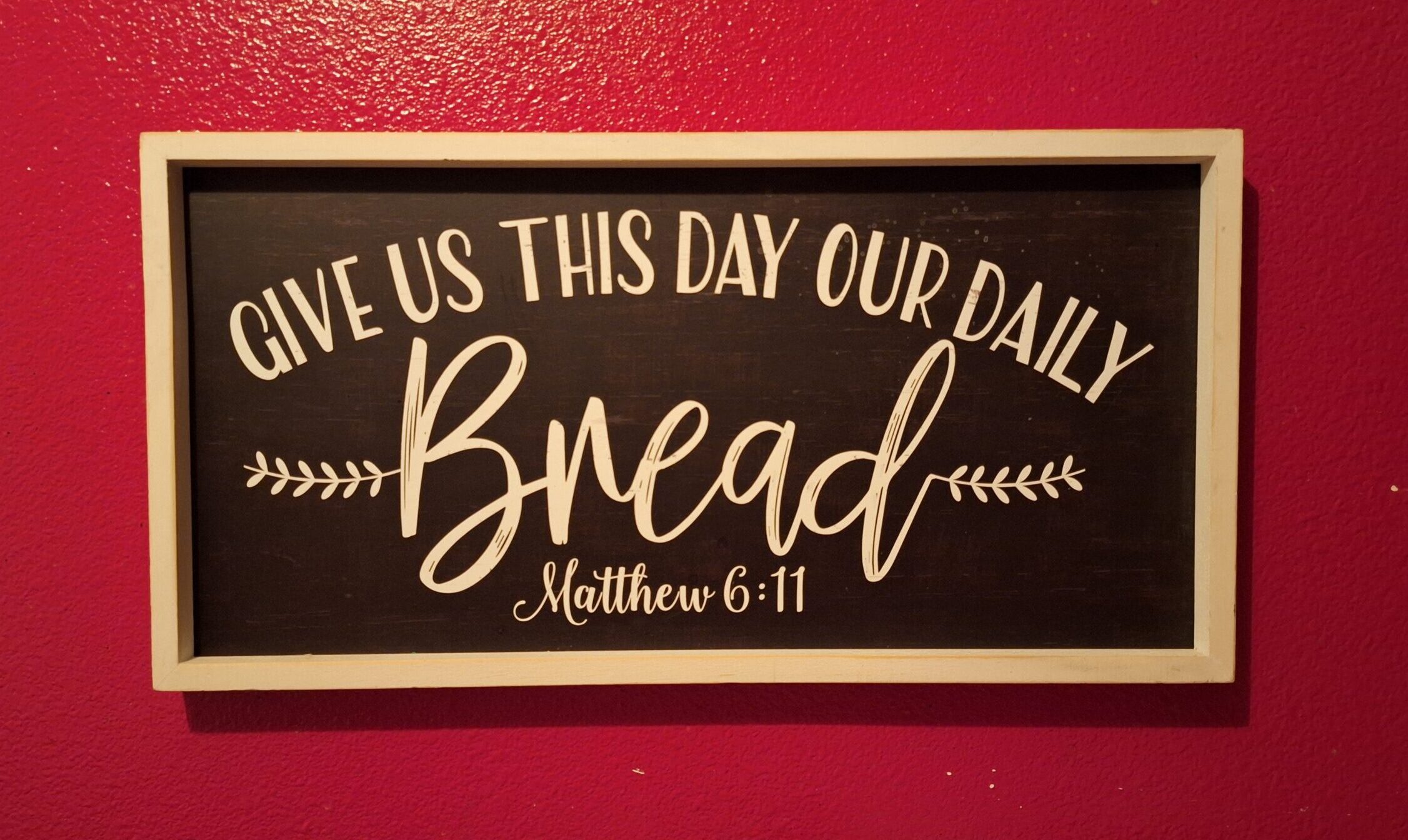
The manna that God sent like rain reminds me of the verse in The Lord’s Prayer featured in our kitchen.
The Sabbath
Believing the first five words of the Bible can change people’s lives. In. The. Beginning. God. Created.
The first concept of Sabbath comes shortly afterwards when God rested after The Creation. He called the Sabbath day holy. The first time God asks his people to observe a Sabbath day—a holy day of rest—is at this time in the wilderness. That surprised me.
Rules, section 2
More rules about manna:
♦ On the sixth day, gather enough for two days.
♦ You must rest on the seventh day—on the Sabbath.
This may not sound like a big deal, but the Israelites had probably never heard the word Sabbath before. This is the first teaching recorded in the Bible about the people being required to rest on the seventh day. Did they obey? Most did, but some didn’t.
It happened on the seventh day, that some of the people went out to gather, and they found none. The LORD said to Moses, “How long do you refuse to keep my commandments and my laws? Look, because the LORD has given you the Sabbath, therefore he gives you on the sixth day the bread of two days. Everyone stay in his place. Let no one go out of his place on the seventh day.” So the people rested on the seventh day.
Exodus 16:27-30, New Heart English Bible
Three things stand out to me from this passage: Scarcity, the details and the matter of trust.
1. A mindset of scarcity
Why did some of the Israelites try to gather manna on Sunday when they were told not to? First, they were accustomed to working seven days a week, most likely. Secondly, they had a mindset of scarcity. Never enough time. Never enough joy. Never enough endurance. Never enough rest. Never enough food.
When you know someone’s history—
the hidden, unspoken things—
their thinking and behavior make sense.
That goes for us too.
Foster children
When I worked for Child Protective Services, some of the children in foster care hid food. A peanut butter and jelly sandwich doesn’t fare very well under the mattress—or in a dresser drawer, for that matter. While these neglected and abused children weren’t experts on food storage, they were definitely experts on food scarcity. What if they don’t feed me tomorrow? Or the next day? Or the day after that? These particular children knew one thing: They had to hide food hither and yon—like squirrels preparing for winter.
Knowing their stories, their behavior made perfect sense. They couldn’t trust adults to feed them. (Until they could.)
Former slaves
In a similar way, some of the Israelites lived with a mindset of food scarcity based on their experiences in Egypt. Their thoughts and fears were the same. They were trapped by their particular flavor of equilibrium. Their behavior reflected what they learned as slaves.
Until it didn’t.
The first issue that caught my attention in the passage above was the subject of scarcity—the explanation for why some of the Israelites looked for manna on the Sabbath, when there was none. Let’s continue to two other issues: Details and trust.
2. The details
Having different rules based on what day of the week it is doesn’t make things confusing or overwhelming for God Almighty. Obviously, God knows what day of the week it is. He doesn’t look up one morning and say, “What’s the date? What time is it? What day is it? Hey, Gabriel! Where’s my calendar?” God knows all that and infinitely more.
Day 1 of the week? “Don’t keep any leftovers or you will seriously regret it.” Day 6? “Store extra for Day 7, knowing that it will be delicious. I know it sounds weird. I know you’re not used to it yet. But I said it and I meant it. You. Will. Rest. On. The. Sabbath. Day.” And the leftover manna? No worms. No smell. No nasty mess to clean up. Isn’t that great?
As many Christians say, “God is in the details.”
Indeed, he is. He made Sabbath rest doable. He was teaching his people important things. Slow down. Think about me. Come together as a family.

3. Trusting God—or not
God wasn’t trying to trick the people of Israel by having different Manna Rules on different days of the week. When God makes the rules, he is more than committed to—and capable of—following them. We can trust him. The question is this. Will we?
The Israelites had a lot of trouble with that—trusting God. Their minds were still in Egypt. Their thoughts were still the same. And life was still hard. Really hard. They were still coping with that shock. Freedom wasn’t all cookies and playtime. It was Hardship 2.0, which was not what they signed up for.
Besides, many of them were now slaves to something silent and unseen—to equilibrium—and they had no idea. They were still living as victims. They said, “This is just the way I am,” not understanding that God made them to be so much more. God was calling them to come close to him in their hearts—to deeply receive all that he had for them. He kept showing them his power and provision and many of them kept rejecting him. They didn’t see themselves or God rightly.
Do we?
Responses to the complaints
Moses heard all the complaining. So did God.
Reassurance
Moses and Aaron said to all the children of Israel, “At evening, then you shall know that the LORD has brought you out from the land of Egypt; and in the morning, then you shall see the glory of the LORD, because he has heard your murmurings against God. Who are we, that you murmur against us?” Moses said, “Now the LORD shall give you meat to eat in the evening, and in the morning bread to satisfy you; because the LORD hears your murmurings which you murmur against him. And who are we? Your murmurings are not against us, but against God.”
Exodus 16:6-8, New Heart English Bible
Translation: “We’ve heard all the whining. Knock it off. The Lord who miraculously rescued you from slavery will provide for you. Take a deep breath and chill out.” While that was a rather pithy paraphrase from Frankie Ann, here’s the bottom line.
The Lord poured out his compassion on his people.
Visible presence
While Aaron was speaking to all the people, “they looked toward the wilderness, and look, the glory of the LORD appeared in the cloud” ~ v. 10, NHEB. The Lord showed the people his presence. Did they understand? Were they comforted? Were they afraid?
The LORD spoke to Moses, saying, “I have heard the murmurings of the children of Israel. Speak to them, saying, ‘At evening you shall eat meat, and in the morning you shall be filled with bread: and you shall know that I am the LORD your God.’”
Exodus 16:11-12, New Heart English Bible
When God said, “…and you shall know that I am the LORD your God,” he was saying loud and clear that he is Jehovah Jireh—the Lord who provides.
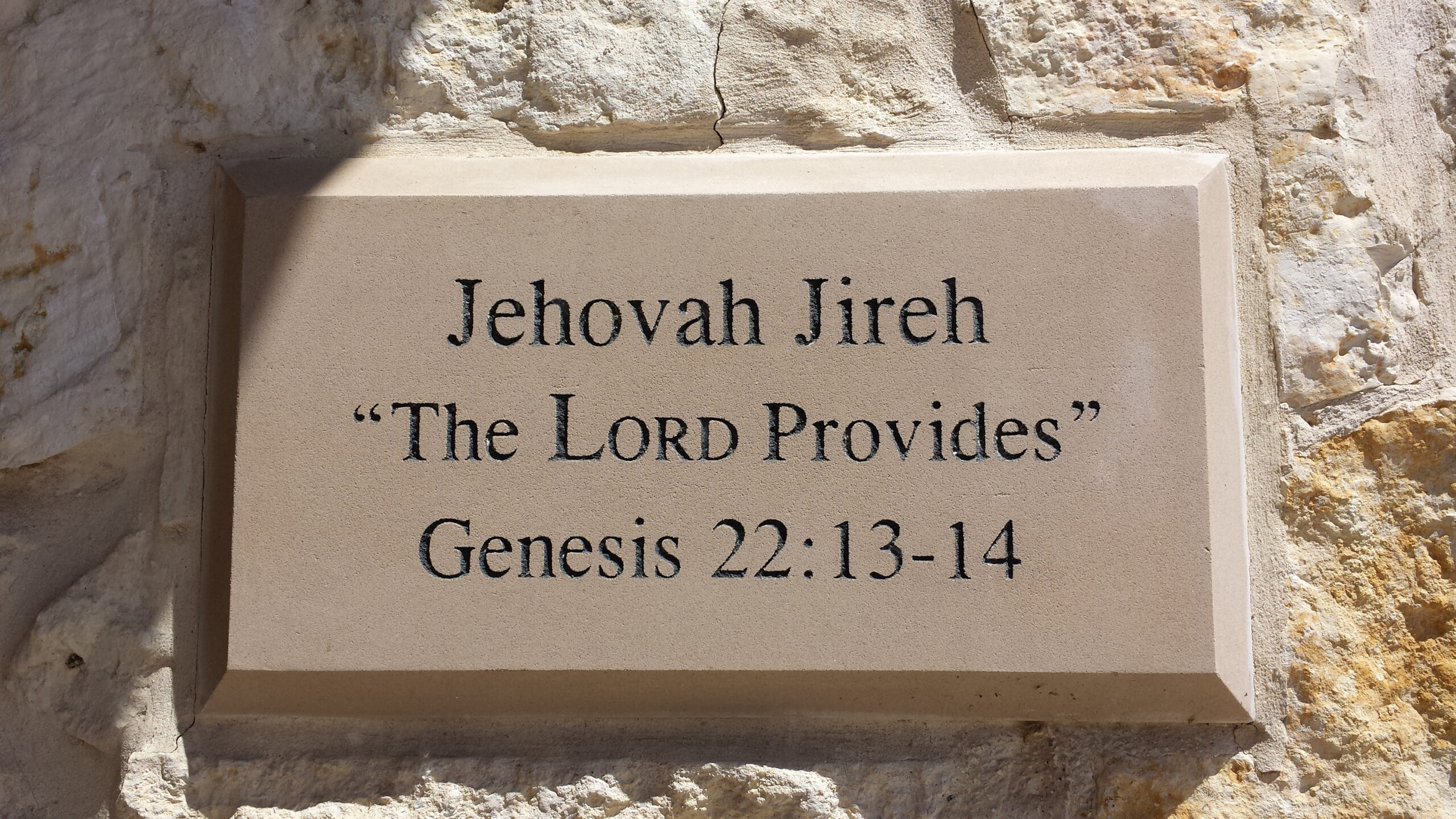
“I am here for you. I am your God.”
Did the people listen? Were they thankful? Did they cling to the Lord who made them and rescued them?
The Lord’s faithfulness
On this and one other occasion, God sent quail into their camp so they could eat meat. And the morning after the people saw the glory of God in the cloud, he sent them manna for the first time. The Lord sent them manna faithfully, every day, for 40 years in the wilderness. Did they learn to trust him? To revere him? Did they come to love the Lord their God and give him their hearts?
The great divide
Unfortunately, many of the children of Israel remained slaves to their equilibrium and forfeited their freedom. But that’s not the end of the story. Which Israelites remained slaves and which ones embraced their freedom—and their God?
Two distinct groups emerged during the nation’s 40 years of wandering in the wilderness.
The older generations
Those who were 20 years old or older when they were rescued from slavery remained slaves to their old ways of thinking, speaking and living. Equilibrium reigned in their hearts.
The Lord held out his hand every day to the children of Israel, giving them manna. Those who were 20-plus years old when they left Egypt took the food, but they didn’t want The Giver. They wouldn’t take his hand. The exceptions to that reality were Moses, Joshua and Caleb. Out of the older generations, these men were devoted to God. They loved, revered and served him faithfully. (Honestly, I’m not sure whether to include Moses’ brother Aaron or sister Miriam in that list.)
During their 40 years in the wilderness, everyone in the older generations died except for Joshua and Caleb. They were the only two who were allowed to enter The Promised Land.
The younger generations
Here’s the good news. Those who were less than 20 years old when they were rescued from Egypt were more impressionable than the older generations. They adapted to their new nomadic lifestyle. Many of them received not only the manna from heaven, but they also received The Giver of the manna—their mighty, loving God.
During the trials of the wilderness,
the younger generations were forged
into a mighty fighting force for the Lord.
At the appointed time, they entered and conquered The Promised Land. What a remarkable time in history.
Your turn
Has God been offering something to you that you’ve rejected? Has he been giving you something good that you’ve failed to acknowledge or thank him for? Is he calling you to come closer?
Pray and ask him to show you what you need to see—and to hold you closer.
Coming next
We’ll dig into The Main Event—when God provided water from a rock in the wilderness. What an epic miracle.
Thanks for reading and for Choosing Peace.
Closing word and song
“My Savior Walks With Me Today” by Dailey & Vincent
Newsletter
To stay current on recent posts, sign up for my monthly newsletter.