Water from the rock
Happy September! For those of us in Texas, we look forward to fewer 100-degree days. What are you looking forward to this month? In our little family, we also look forward to a couple birthdays. Have I mentioned how much I love cake? Indeed, I have.


Displaying our colors
People display their colors of devotion or fandom in their clothing, bumper stickers, signage at home, décor, jewelry and more. From the final post about the epic life of Queen Esther:
We have an American flag and a Texas flag on our house and a sign in our flower bed that begins “We believe….” People are proud to display their colors—whether they have a cross on their house or a swastika.
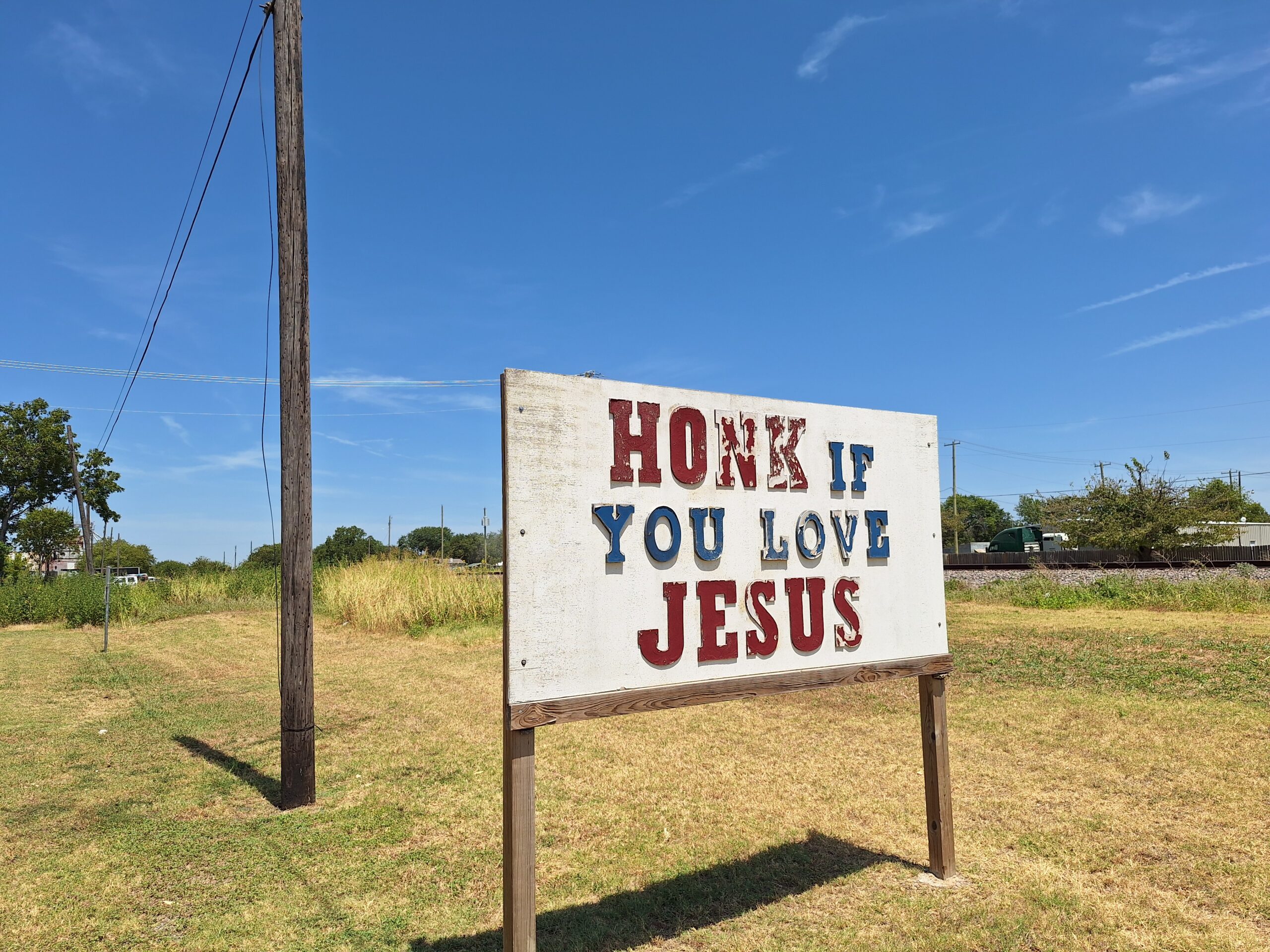
It warms my heart when I see Christians displaying their colors. Look what my pal Charlene and I saw last month in the little town of Itasca, Texas.

The owner of the van epitomizes this Bible verse:
For I am not ashamed of the Good News of Christ,
because it is the power of God for salvation for everyone who believes….
Romans 1:16a-b, World English Bible
The people of Glen Rose, my favorite small town, also live out that verse. Enjoy the photos featured in this recent post.
Aversion and hostility
Peaceful Reader, have you experienced rudeness, hostility or persecution because you’re a Christian—a follower of Jesus Christ? If you’ve ever encountered a grocery store checker who chats with the customers before and after you, yet won’t speak to you or look at you, then you’ve experienced what I’m talking about. While the checker in question likely doesn’t know why he or she felt an extreme dislike or aversion to you, the reality is this: The darkness hates the light.
Jesus said:
“This is the judgment, that the light [—Jesus Christ—] has come into the world, and men loved the darkness rather than the light, for their works were evil.”
John 3:19, World English Bible
I recently experienced this aversion and hostility twice on the same day, when I wore a T-shirt with the name of Jesus on it. Most interesting—and revealing.
Exploring Christianity
If you’re not a Christian and would like to know more, read the Thanksgiving posts and my salvation story (part 1 and part 2). See the index and recommended books. Is God calling to you? Quietly? Through your circumstances?
Seek him….
Stone-cold
Today we’ll explore the miracle when God provided water from a rock for the nation of Israel as they wandered in the wilderness. As we dig into this event, we’ll see hostility toward God and his chosen leader, Moses. The words spoken by some of the people revealed their stone-cold hearts.


Last time, in part 9, we reflected on manna, the bread which the Lord began providing daily for the children of Israel after he rescued them from slavery in Egypt. “Manna from Heaven” was the Before Event. “Water from the Rock” is The Main Event in this group of Before and After posts. (See the beginning of part 8 for a summary of these posts.)
Get ready to read about Blame Throwers, the good way, and an Old Testament billboard.
Complaints 2.0
The children of Israel obeyed the Lord, traveling from one area in the wilderness to Rephidim. There wasn’t any water available.
Therefore the people quarreled with Moses, and said, “Give us water to drink.” Moses said to them, “Why do you quarrel with me? Why do you test the LORD?” The people were thirsty for water there; and the people murmured against Moses, and said, “Why have you brought us up out of Egypt, to kill us, our children, and our livestock with thirst?” Moses cried to the LORD, saying, “What shall I do with these people? They are almost ready to stone me.”
Exodus 17:2-4, New Heart English Bible
Right before this incident, the people made similar complaints about their hunger. And the Lord rained manna down from heaven to feed them daily. They saw his glory in the cloud. He taught them about resting on the Sabbath. They knew the manna came from him—daily, miraculous provision directly from the hand of God Almighty.
Which begs this question: Since the people knew that their food was being provided by God himself, why didn’t they ask Moses to ask God to provide them with water? They argumentatively said to Moses, “Give us water to drink.” In other words, “You give us water to drink. We won’t ask God or acknowledge his obvious ability to meet our need.” Understandably, Moses replied: “Why do you quarrel with me? Why do you test the LORD?” (v. 2b, NHEB).
Hostility instead of humility
The people appeared unwilling to acknowledge (1) God’s rescue of them from slavery, (2) his power and protection in annihilating the Egyptian army, (3) his daily provision of manna—bread from heaven, (4) his presence shown to them daily, and (5) his obvious ability to meet their need for water. Instead of humbling themselves and asking God for help, they chose to fight with Moses—God’s man.
Was their unwillingness to trust God at the heart of their combativeness? Was it about their desire for control? Were they hostile because God chose their leader and they didn’t get a vote?
Voting—or not
Speaking of voting, do you remember student council elections during high school? The nomination process. The posters in the hall. The campaign speeches. The buttons to wear. The different groups supporting different candidates. The voting process. The victory celebrations.
Maybe the Israelites would’ve liked student council and city council elections. Then again, maybe they would’ve rigged the elections. Stranger things have happened, right? Either way, the people of Israel said loud and clear, via their complaining: “We didn’t pick this guy! God didn’t even ask for our input. We wanted so-and-so. Why should we listen to Moses?”
Bad choices
Since the Israelites didn’t trust the Lord, they rejected God’s choice—Moses. The people chose conflict instead of gratitude. They chose pride instead of humility. They chose complaining instead of problem-solving. They chose hostility instead of unity. They chose to verbally attack their leader instead of simply asking for his help.
Unchanged
Despite all the miracles performed by God in their presence, including the daily miracle of manna—which they’d never seen before—the people of Israel were unmoved. They were unchanged.
The people revealed their lack of trust in God and in Moses.
The people revealed their hostility.
The people revealed their stone-cold hearts.
To explore the people’s problematic thoughts and feelings, read part 9.
Projection
Let’s zero-in on the last verse from the Bible quote above.
Moses cried to the LORD, saying, “What shall I do with these people? They are almost ready to stone me.”
Exodus 17:4, New Heart English Bible
While most violence is emotional, things were clearly escalating in the wilderness, and stoning was a common execution method.
Just like they did in the Before Event—manna from heaven—the people accused Moses of wanting to kill them, which was patently ridiculous. Were they demonstrating one of the tried-and-true tactics of troublemakers? Were they engaging in the violent practice of projection? Were they accusing Moses of what they were plotting? Absolutely, Peaceful Readers. No doubt about it.
We think the crazy things going on these days are all new-fangled, but the truth remains: There’s nothing new under the sun (from Ecclesiastes).

Violence
Was Moses exaggerating about what was going on? No. He wasn’t dramatic or paranoid. He had a very clear pulse on the people he was leading. And God didn’t say, “Oh, it’s not that bad.” It was that bad.
Did the people have stones hidden in their tents? In their pockets? In their hands?
From part 9:
[The Israelites] were surrounded by people who were complaining. Discontent spreads like wildfire. Beware when you hear: “Everybody thinks…,” “Everybody says…” or “Everybody knows….” Group think can be very dangerous. We saw that during COVID, didn’t we? And dissenting voices can be met with great hostility and even violence. Groups large and small can quickly fracture into Us vs. Them camps.
Danger
The people stockpiled all their anger and violence during a lifetime in slavery. As the saying goes: “They were hoppin‘ mad.” Then they aimed their pent-up anger and violence squarely at Moses. They couldn’t fight back against their Egyptian taskmasters, but they could most definitely murder Moses. They knew it and he knew it.
Moses believed he was in mortal danger, and I believe him.
God knew each person’s heart and mind,
including every word—spoken or unspoken.
God knew about any and all of the plotting, the alliances, the planned replacements, the financial arrangements, the promises, the rock collecting, the names on the hit list. For similar behavior, read this post about Daniel and the lions’ den.
God also knew it was time for action.
Water from the rock
Let’s explore The Main Event.
The LORD said to Moses, “Walk on before the people, and take the elders of Israel with you, and take the rod in your hand with which you struck the Nile, and go. Look, I will stand before you there on the rock in Horeb. You shall strike the rock, and water will come out of it, that the people may drink.” Moses did so in the sight of the elders of Israel.
Exodus 17:5-6, New Heart English Bible
Many thousands of people needed to drink, as did their livestock. We don’t know the details of how much water flowed, how quickly or widely it flowed, or how it was contained and captured. We do know this. God did it and he did it right.

The elders
I find it noteworthy that God said the elders had to be present. They had to walk with Moses—a sign of unity—and they had to watch Moses perform the miracle. Were some of them part of the conspiracy that I believe was in play against Moses? They had the most to gain and the most resources to pull it off, didn’t they? I’m just reflecting on what I know about human nature and people who hunger for power. Were some of the elders like Haman, the high administrator who plotted genocide in the story of Queen Esther? I wonder….
The water
God opened up the heavenly tap and shut down the wicked people’s plot simultaneously. I love that. He made the situation crystal clear: Moses is my man. I have empowered him to work miracles for the good of the nation. Don’t even think about touching him.
Speaking of water, the Egyptian army was drowned—not hung, not exploded, not eaten by wild animals, not killed by man-made weapons, not stoned. They were all drowned. God Almighty used water to wipe them out. And the people, including the elders, saw it. The elders knew full well what God was capable of doing with water. He could, in one fell swoop, take out his enemies.
Hopefully the elders behaved better after The Main Event—water from the rock. Sadly, we know from this passage that they never gave their hearts to God. This slice of the exodus reminds me of the Pharisees and Jesus.
Commemoration
How did The Main Event end?
[Moses] called the name of the place Massah, and Meribah, because the children of Israel quarreled, and because they tested the LORD, saying, “Is the LORD among us, or not?”
Exodus 17:7, New Heart English Bible
I’m laughing my head off. Moses basically named the location of this epic miracle thusly: “The Blind Whiners.” In other words, “I’m putting up a permanent Old Testament billboard declaring your bad behavior for all generations to come. Happy waterfall to you.”

Who said there’s no humor in the Bible? Moses had a great sense of humor.
Unbelief
In the verse quoted above, why would some of the people say: “Is the Lord among us, or not?” (v. 7c). The Israelites were eating the manna that God rained down in the wilderness every single day. From the time they departed from Egypt, God led them with his visual presence.
God went before them by day in a pillar of cloud, to lead them on their way, and by night in a pillar of fire, to give them light, that they might go by day and by night: the pillar of cloud by day, and the pillar of fire by night, did not depart from before the people.
Exodus 13:21-22, New Heart English Bible
Why did the adult Israelites not see God rightly? Why did they not revere and honor him? Why were they not grateful to him? Some of the answers can be found in part 9. But God’s word gives us the best answer.
The Lord’s servant must not quarrel, but be gentle towards all, able to teach, patient, in gentleness correcting those who oppose him: perhaps God may give them repentance leading to a full knowledge of the truth, and they may recover themselves out of the devil’s snare, having been taken captive by him to his will.
2 Timothy 2:24-26, New Heart English Bible
Captives
The devil has taken unbelievers captive. His lies spin in their minds. Their hearts are stone-cold. They reject the truth and cling to the devil’s lies. The big bang theory. Atheism. Calling a baby “a lump.” No accountability or afterlife. “Trust the science.” Read this interesting article about scoffers. See Abortion, Evil, Satan and more in the index.
Paul reminds us in his letter to Timothy, quoted above, that repentance is a gift from God.
Sadly, most people refuse God’s gifts
and live as if he doesn’t exist.
These truths certainly apply to the Israelites wandering in the wilderness and to people today, also wandering in the wilderness of life without God—their Creator, heavenly Father, the Lord Almighty.
Destruction
The three verses above come from a larger passage well worth reading. It includes this warning about the destructiveness of “irreverent babble” (v. 16a, ESV).
But shun empty chatter, for they will proceed further in ungodliness, and their word will consume like gangrene….
2 Timothy 2: 16-17a, New Heart English Bible
Gangrene eats away what was once healthy, and results in catastrophic loss of limb and/or life. When the Israelites projected their hostility onto Moses, claiming that he wanted to kill them, they were displaying what the devil’s lies and their own unbelief had done to their hearts and minds. They were being eaten up from the inside out, but they didn’t see it. They kept whipping out their Blame Throwers—complaining, targeting, projecting. And they paid the ultimate price. To read about heaven and hell, see the Final Destinations section in part 8.

Good gifts
God gives good gifts to all people, including these extremely basic, essential things: air, water and food.
For [your Father who is in heaven] makes his sun to rise on the evil and the good, and sends rain on the just and the unjust.
Matthew 5:45b, New Heart English Bible
In their struggles, the Israelites were certainly made aware of their desperate need for water and food. Even so, they didn’t ask God for help. They just complained and attacked Moses, their unwanted, disrespected leader—chosen by God, yet rejected by the people. That reminds me of Jesus and his rejection by the Jews.
God’s kindness can lead people to repentance and salvation. And God’s sovereign plan can take someone from “the big bang theory” to “intelligent design” to “Jesus is Lord.” Hallelujah!
The good way
Drink in the beauty, perfection and truth of this Old Testament verse:
Thus says the Lord: “Stand by the roads, and look, and ask for the ancient paths, where the good way is; and walk in it, and find rest for your souls. But they said, ‘We will not walk in it.’”
Jeremiah 6:16, Revised Standard Version*
*Revised Standard Version of the Bible, copyright © 1946, 1952, and 1971 the Division of Christian Education of the National Council of the Churches of Christ in the United States of America. Used by permission. All rights reserved.

The good way is found on the ancient paths. Not the new stuff. We find the ancient truths in God’s holy, inerrant word, the Bible. Being called “old fashioned” can be one of the highest compliments around. Seek the good way.
♦ Salvation through faith in Jesus Christ
♦ Marriage between one man and one woman
♦ Children raised to love the Lord
♦ Sharing the Good News of Jesus Christ
♦ Worshiping God in a church where the Bible is faithfully taught
Not all Christian churches are faithful to Jesus and to the Bible. Read part 4 of The Joy of the Lord for clarity on what to look for in a church. Pray to God and ask him for wisdom and discernment. Take your time exploring Evil in the Church under the topic of Evil in the index.
Did you notice the last sentence of that wonderful verse in Jeremiah 6 about the good way? “But they said, ‘We will not walk in it’” (v. 16d, RSV). The people said, “No. We don’t want it. We don’t want the good way. We don’t want to obey God. We don’t want rest for our souls. We don’t want anybody telling us what to do. We want to do our own thing.” I understand. I used to live that way. Hear me when I say it. Life with God is so much better. He is our faithful provider and protector.
The Lord’s protection
The Lord protected Moses throughout his life. What a remarkable story. And God has protected us too—often in ways we never comprehended. Frozen on the Freeway describes one of the epic miracles in my life. (For more, see Miracles on the home page or in the index.)
The Lord is our protector.
Do you need encouragement in this area? See the section in the index called Protected by God.
Your turn
Think about some of the many ways God has protected you throughout your life. Get out your journal or a piece of paper and start making a list of what comes to mind. Reflect on this section from part 3:
The connection between provision and protection
One thing we often fail to recognize is the intrinsic relationship between provision and protection.
When the Lord provides us with the basics, he’s protecting us from poverty. When the Lord provides us with food, he’s protecting us from hunger and starvation. When the Lord provides us with clean water, he’s protecting us from thirst, disease and poor hygiene. When the Lord provides us with shelter, he’s protecting us from the elements and from being victims of crime. When the Lord provides us with clothing, he’s protecting us from illness, injury and rejection. When the Lord provides us with strength and balance, he’s protecting us from falling down. When the Lord provides us with caring loved ones, he’s protecting us from loneliness.
Can you think of some other examples?
Pray and thank the Lord for his protection of you and your loved ones. Share your Protected By God stories with others as the Lord leads you.
The Lord, our healer
At the end of Exodus, chapter 15, right before the beautiful chapter about manna, we learn something vital about the Lord God.
There he made a statute and an ordinance for them, and there he tested them; and he said, “If you will diligently listen to the voice of the LORD your God, and will do that which is right in his eyes, and will pay attention to his commandments, and keep all his statutes, I will put none of the diseases on you, which I have put on the Egyptians; for I am the LORD who heals you.”
Exodus 15:25c-26, New Heart English Bible
Translation: “If you choose the good way and make me the Lord of your heart, mind and life, I will be your healer.” While we’re always encouraged by a miraculous physical healing, I assert that a mental, emotional, relational or spiritual healing is no less remarkable.
Dad
Last month, I read In the Company of Others. On the first page of chapter 32, author Jan Karon poetically described love for broken, distant parents, which warmed my heart. I understood. Around the same time, I journaled about that very thing.
Saturday, August 15
Journal entry
Brandon and I watched Top Gun 2: Maverick [—fast-forwarding thru the romance scenes]. I enjoyed the training/flying parts. I thought about Dad, his courage as a naval aviator, and thanked God for him. He loved photography and writing, as I do. Thank you, heavenly Father, for my life and your gracious sovereignty over all things.
The Lord healed my heart toward my dad, the narcissist. I wrote my anger letter to him nine years ago this month—on my sociopathic mother-in-law’s birthday, no less. I had a lot to say. And seven months later, I journaled about a night when I wrestled with God—throwing a fit about not wanting to see my parents when I get to heaven. Two days later, I changed my mind. In reality, the Holy Spirit was helping and healing me. And here we are now. I look forward to hugging and kissing my parents in heaven and experiencing them in glory—healed, whole and free from chains. Thank you, Lord, for loving, teaching and healing me—one step at a time. You are so faithful.
All glory now and forever to King Jesus.
The words of this song remind me of so many aspects of today’s post. Be blessed as you listen to “All Glory Be to Christ.”
A special Choosing Peace birthday
Ten years ago this month, I started writing Choosing Peace, and published my first-ever post two months later. Ten years, Peaceful Readers! Can you believe it? What a remarkable time in my life. Thank you for reading Choosing Peace. I hope you’ve been blessed.

Speaking of the number ten, check out this recent post about Jesus healing the ten lepers, plus the significance of the number ten in my life.
Summary
We’ve covered a lot today. Here’s a brief summary.
Seven key points:
1. The Israelites didn’t trust God, so they rejected his chosen leader: Moses.
2. They projected their violent plotting onto Moses, claiming he wanted to kill them.
3. The people demanded water from Moses, but they wouldn’t ask God for help.
4. The Lord instructed and empowered Moses to perform a miracle: water from the rock.
5. The vast majority of the adults in the nation of Israel were spiritual captives of the devil.
6. God offers us the good way to live, but most people reject it.
7. The Lord is our protector and our healer. All glory now and forever to King Jesus.
Closing
In keeping with the subject of the good way and being old fashioned, I hope you thoroughly enjoy the ragtime song below by the one and only Scott Joplin. I used to play the “Maple Leaf Rag” on the piano. It was tricky. Tuba Skinny does it up right—playing outside in the French Quarter and making you want to dance.
Let’s close this post the way it opened—with the good people of Itasca displaying their colors.
Coming next
We’ll dig into the After Event for this group, about the Israelites battling the Amalekites. It’ll be exciting.
Thanks for reading and for Choosing Peace.
Closing word and song
“Maple Leaf Rag” performed by Tuba Skinny
Newsletter
To stay current on recent posts, sign up for my monthly newsletter.